Event 1
Odonian Revolution
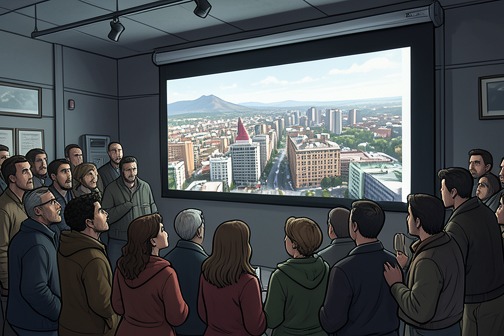
The [Odonian Revolution](entity:event-recall-event-odonian-revolution-395c58adfa12) is the uprising and social transformation on [Urras](entity:location-recall-location-urras-cc6169219e59) that produced the Odonian exodus to [Anarres](entity:location-recall-location-anarres-8af77930b83c). Its consequence was more than a change of political allegiance: a million people crossed the dry abyss to found a society organized around collective provision and decentralized life. Yet the revolution’s departure from Urras left its achievement entangled with exile. [Shevek](entity:character-recall-character-shevek-c03b61cb02ce)’s journey back to Urras turns that history into a live question: whether solidarity can cross the wall between worlds without becoming another instrument of power.
## Origins and Historical Break
The revolution is remembered by the young Shevek and [Tirin](entity:character-recall-character-tirin-4a5be42f0632) through films of life on Urras. Kvetur assumes that the images show conditions from before the revolution and that nothing has changed since the Odonians left; Tirin challenges the certainty of that assumption. This early exchange makes the revolution’s history a matter of contested knowledge as well as a point of origin: the people of Anarres have inherited a story about the world they departed, but cannot simply verify what became of it.
The settlement of Anarres followed a longer history of mining and political maneuver. For two centuries after its discovery, the moon was explored but not colonized. As Urras’s mineral lodes were depleted, mining there became economically attractive. A settlement at [Ans Hos](entity:location-recall-location-ans-hos-63fa23a78b48), later called Anarres Town, was founded in IX-738 to mine mercury; its male workers generally signed on for two or three years before returning to Urras. Meanwhile, [Thu](entity:location-recall-location-thu-cf94fc430d08) secretly maintained a rocket base and a gold-mining settlement with families in the moon’s eastern hemisphere. After Thu’s government collapsed in 771, the [Council of World Governments](entity:organization-recall-organization-council-of-world-0f75bde759d9) proposed transferring the moon to the [International Society of Odonians](entity:organization-recall-organization-international-so-b899075c3eb7), hoping to contain a movement that threatened law and national sovereignty on Urras. Anarres Town was evacuated, and rockets sent to retrieve Thu’s miners; some chose to remain in the desert.
The revolution’s migration was organized on a vast scale. Over more than twenty years, the twelve ships granted to the Odonian settlers carried a million people to Anarres. Once the migration was complete, the port was closed to immigration and left open only to freight ships under the trade agreement. Anarres Town, which by then held a hundred thousand people, became [Abbenay](entity:location-recall-location-abbenay-98fb15d5f0b8), a name meaning Mind in the new language. The revolutionary break thus produced both a new social beginning and a deliberately restricted connection with the old world.
## The Society the Revolution Set in Motion
[Odo](entity:character-recall-character-odo-5a1f3aaae2aa)’s political vision sought decentralization without isolation. She did not intend to abolish cities; she imagined communities connected by communication and transport, allowing goods and ideas to reach those who wanted them. Administration, in that vision, would not be run from above: there would be no controlling center, capital, or permanent bureaucratic establishment. On arid Anarres, however, scattered settlements depended on extensive exchange because few could support themselves. The settlers held to a complex, interconnected economy rather than retreating into isolated, pre-urban life, building roads before houses and exchanging regional products continually.
Shevek understands the revolutionary departure as a refusal of inherited history, but comes to see the cost of treating refusal as achievement. In the old Senior Faculty House on Urras, a room built centuries before the settlement, its enduring beauty confronts him with generations of work and memory. He concludes that the settlers had been wrong to deny their history and forgo the possibility of return. An explorer who never comes back or sends a ship to report what has been found, he reflects, is only an adventurer; the descendants are left in exile. His love for Urras does not make him part of it, any more than birth makes him feel securely part of Anarres. The revolution’s founding separation therefore becomes personal as well as political: he belongs fully to neither world.
## Revolution, Power, and the Wall
Shevek goes to Urras hoping to reopen exchange, not to restore the old order. He tells [Chifoilisk](entity:character-recall-character-chifoilisk-d42dce4ec0c0) that he came to bargain with a profit economy, seeking an end to the exile of his people, the removal of barriers, and human solidarity between Urras and Anarres. He believes [A-Io](entity:location-recall-location-a-io-fcd52e3420b2) fears him less than Thu does because A-Io has forgotten the revolution and supposes that material possessions can make people content within confinement. His appeal to the revolutionary past is therefore a demand to continue its work, not a claim that its historical settlement solved the problem of freedom.
That demand takes the form of a refusal to sell knowledge as a source of private or national advantage. Shevek asks whether there can be a gift instead of a sale, and says he wants to give his theory to [Keng](entity:character-recall-character-keng-aa9da29f851b), [Hain](entity:location-recall-location-hain-aee202d20a49), and the countries of Urras so no one power can use it to dominate others, grow richer, or win wars. The exchange echoes his arrival on Urras: unable to buy food in a society where necessities are purchased, he had called himself the Beggarman and insisted that, if he was to be kept alive, his hosts would have to give. His empty hands are not passivity; they expose the different assumptions that govern sharing and commerce. In offering his theory freely, he makes the same contrast a deliberate political act.
The novel also shows how political authorities can narrow the space for exchange. During the declared war involving A-Io and Thu, research can be classified, publication delayed, and foreign scholars’ travel restricted; Shevek is told he should not leave campus without the Chancellor’s clearance. At the [Nio Esseia](entity:location-recall-location-nio-esseia-f772168c8bdc) demonstration, helicopters drown out the crowd and fire on people gathered near the Directorate. Soldiers enter the building over the dead and wounded, where the word DOWN has been smeared in blood on a wall. These scenes do not depict the original revolution itself, but they sharpen the stakes of its unfinished promise: state power can restrict movement and knowledge, and answer public assembly with violence.
## Exile and the Unfinished Return
The boundary created by the settlement remains explicit in its closure terms. During a discussion on Anarres, [Rulag](entity:character-recall-character-rulag-f4723d9ee7ed) states that a person may leave if the propertarian freighters will take him, but cannot come back; she identifies the rule as the Terms of the Closure of the Settlement, which bar anyone from leaving the freight ships beyond the boundary of the [Port of Anarres](entity:location-recall-location-port-of-anarres-6d3478c40bba). The rule turns the settlers’ historical departure into an ongoing condition. Return is not simply a personal choice when access to the port is controlled by a legal boundary and dependent on ships from Urras.
The Odonian Revolution consequently stands in the novel as both a founding achievement and an unfinished process. Its followers created a radically different society, but their separation from Urras made the revolutionary movement’s history vulnerable to simplification and its people vulnerable to permanent exile. Shevek’s return, his effort to bargain across the divide, and his offer to share rather than sell his theory recast revolution as renewed contact: not possession of a completed ideal, but the continuing work of breaking walls without reproducing domination.
Event 2
Settlement of Anarres
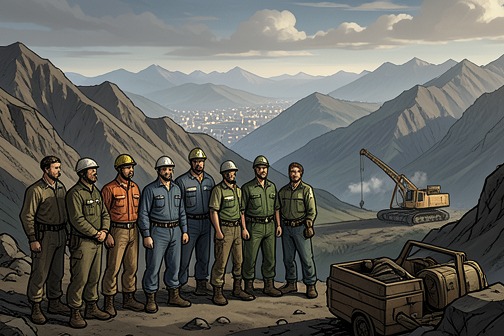
The [Settlement of Anarres](entity:event-recall-event-settlement-of-anarres-cddedb63298d) was the migration of a million Odonians from [Urras](entity:location-recall-location-urras-cc6169219e59) to the Moon and the founding of a society organized around [Odo](entity:character-recall-character-odo-5a1f3aaae2aa)’s anti-authoritarian principles. It began as a political concession intended to contain the Odonian challenge to law and national sovereignty, but became a lived experiment in decentralized cooperation: one that carried its ideals across a dry abyss while binding the new society to a closed border and a difficult ecology.
## Political Origins and Migration
[Anarres](entity:location-recall-location-anarres-8af77930b83c) had been explored and mined before it was settled. The Urrasti year IX-738 saw a mining settlement founded at the foot of the [Ne Theras Mountains](entity:location-recall-location-ne-theras-mountains-c0b8e7e9de2a), where mercury was extracted in the old [Ans Hos](entity:location-recall-location-ans-hos-63fa23a78b48) region. Called Anarres Town, it was a temporary work camp rather than a permanent community: men signed on for two or three years and then returned to what they regarded as the real world. Separately, [Thu](entity:location-recall-location-thu-cf94fc430d08) maintained a secret rocket base and a settlement of goldminers with their families in the Moon’s eastern hemisphere. When Thu’s government collapsed in 771, the [Council of World Governments](entity:organization-recall-organization-council-of-world-0f75bde759d9) proposed giving the Moon to the [International Society of Odonians](entity:organization-recall-organization-international-so-b899075c3eb7). The transfer was meant to buy off a movement that threatened the authority of law and national sovereignty on Urras. Anarres Town was evacuated, and rockets sent amid the turmoil in Thu retrieved the goldminers, though some chose to remain on the Moon.
Over more than twenty years, twelve ships granted by the Council carried the Odonians across the interplanetary distance. The migration brought a million people who chose the new life; when it was complete, immigration ended and the port remained open only to freight ships operating under the Trade Agreement. The former Anarres Town had grown to a hundred thousand people and was renamed [Abbenay](entity:location-recall-location-abbenay-98fb15d5f0b8), meaning Mind in the new language. The scale and duration of the crossing make the Settlement both a political departure from Urras and the material beginning of a new social order.
## An Ideal of Decentralized Society
Odo’s plans rejected a controlling center, a capital, and the bureaucratic machinery through which individuals might become bosses or state leaders. She did not propose dismantling urban civilization. Instead, she envisioned connected communities linked by communication and transportation, allowing goods and ideas to reach where they were wanted without a hierarchy directing the network from above. Communities were to have a natural limit set by dependence on their immediate regions for essential food and power, yet remain open to interchange rather than isolated from change.
Anarres made that ideal harder to realize. Its aridity forced communities to spread widely in search of resources, and few could support themselves, even after residents sharply reduced their expectations of what counted as necessary. The settlers refused a return to pre-urban, pre-technological tribal life: they understood their anarchism as dependent on advanced technology, high production, and rapid transport. They built roads before houses, then relied on continuous exchange among regions with different resources and products. The intended result was not self-sufficiency everywhere but an intricate balance of diversity, a social ecology held together without a central authority.
## Ecological Limits and Collective Work
The Moon’s ecology set severe limits on what the settlers could bring or sustain. Anarres had abundant marine life, but on land its sparse plants and limited animal life reflected a long climate of dust and dryness. Human settlement depended on careful adaptation: fishing without exhausting the seas, cultivation, and the use of organic waste as fertilizer. There was no grass to support herbivores and therefore no basis for carnivores; flowering plants lacked insect pollinators, so imported fruit trees had to be fertilized by hand. Animals were not introduced from Urras for fear of upsetting the delicate balance, and the settlers arrived scrubbed well enough to bring very little of their own flora and fauna.
The history of the Dust gives that scarcity a longer timescale. In an earlier geological era, the region had been covered by holum forest. A hotter, drier climate and millennia of drought killed the trees and reduced the soil to fine grey dust, which winds shaped into barren hills. The settlers hoped to restore fertility by replanting the forest. The afforestation of the [West Temaenian Littoral](entity:location-recall-location-west-temaenian-litto-07b49c477603) later became one of the Settlement’s major undertakings, employing nearly eighteen thousand people for two years. Its effort joined practical work to a wider Odonian aspiration: to reverse, through collective labor, damage that had accumulated over geological time.
## Culture, Memory, and Closure
The settlers’ break with Urras was also an effort to make a new culture. They adopted made-up names and learned a made-up language; one account describes them as romantic, while the society that followed is characterized as pragmatic. Their first attempts to create poetry in the new language were described as stiff and ungainly, yet moving. A poem written by Pio Atean, who took the Pravic name Tober, in the Settlement’s fourteenth year preserves the hesitant emergence of that new expressive life.
The settlement’s founding did not erase the danger of renewed dependence or political control. Its terms barred Urrasti from going beyond the boundary of the port, a restriction later defended as the safeguard of the experiment against outsiders and possible re-enslavement. The rule also meant that the boundary could be interpreted to bar return by an Anarresti who had left. Decades later, [Shevek](entity:character-recall-character-shevek-c03b61cb02ce) questioned the assumption that the terms applied to every foreigner, reasoning that the original prohibition addressed Urrasti and that extending it to other peoples merely built more walls. His challenge exposes the Settlement’s lasting contradiction: its separation protected the society from outside domination, yet could harden into isolation that restricted contact and individual choice.
## Significance
The Settlement is the founding act behind Anarres’s experiment in nonauthoritarian communism, but the story presents it neither as a simple escape nor as a completed solution. Its origins lie in a strategic bargain by governments seeking to contain Odonian influence; its achievement lies in making a functioning society across an inhospitable world through transportation, regional exchange, and shared labor. Its vulnerability lies in the same conditions that shaped it: ecological scarcity, dependence on coordination, and a closed border justified as protection.
The migration therefore remains an active political question rather than a settled historical episode. Anarres’s principles depend on connection and voluntary cooperation, while its founding terms enforce separation from Urras. That tension—between a society’s defense of its independence and the walls that may confine it—gives the Settlement its continuing significance in the novel.
Event 3
Insurrection of 747
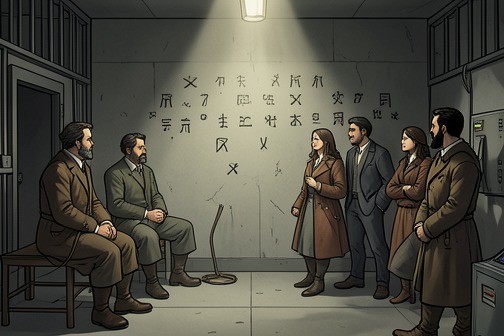
The [Insurrection of 747](entity:event-recall-event-insurrection-of-747-9806e6f8c9ee) is the uprising that preceded [Odo](entity:character-recall-character-odo-5a1f3aaae2aa)’s nine-year imprisonment in the [Fort in Drio](entity:location-recall-location-fort-in-drio-2c4a332466e3), linking the founding generation’s struggle against authority to the later society’s uneasy memory of coercion. Its narrative significance lies less in a dramatized account of the revolt than in the prison it left behind: a historical fact children must learn to imagine and a ruin [Shevek](entity:character-recall-character-shevek-c03b61cb02ce) encounters across the divide between [Anarres](entity:location-recall-location-anarres-8af77930b83c) and [Urras](entity:location-recall-location-urras-cc6169219e59).
## Historical Context and the Prison
The uprising is identified in connection with [Odo’s imprisonment](entity:state-recall-state-odo-s-imprisonment-4413b47cc1d4): after the Insurrection of 747, Odo spent nine years in the Fort in Drio. She wrote the Prison Letters there, as well as the Analogy. These works and the image of Odo in her cell preserve the revolt’s aftermath within the history read by later generations, even when the uprising itself is not narrated in detail.
For children in [Wide Plains](entity:location-recall-location-wide-plains-a342257271e2), the history becomes a lesson in institutions that their own society has largely rendered unfamiliar. Those studying History read episodes from the Life of Odo, but the book contains obscurities and no local teacher can fully explain them. When it reaches Odo’s years in the fort, however, the idea of a prison becomes intelligible through the scene of confinement. A visiting circuit history teacher explains that a State imprisoned people who disobeyed its Laws: locked doors kept them in, and some were sentenced to labor under threat of being beaten if they refused.
The children’s questions expose the violence hidden inside these apparently technical explanations. They ask why prisoners cannot simply leave, what they do in a room all day, and what a sentence means. When [Tirin](entity:character-recall-character-tirin-4a5be42f0632) voices the question of whether many people would beat one person, the teacher confirms it. The children, aged eleven and twelve, have never been struck or seen anyone struck except in immediate personal anger; organized punishment is therefore not an abstraction but a shocking social possibility.
## The Fort’s Afterlife
Years later, Shevek asks to see the Fort in Drio while visiting Urras. [Chifoilisk](entity:character-recall-character-chifoilisk-d42dce4ec0c0) asks why he wants another castle, and Shevek answers that Odo spent nine years there after the Insurrection of 747. Pae says the fort has been pulled down: [Drio](entity:location-recall-location-drio-76ce427e1a2d) was a moribund town, and the Foundation rebuilt it entirely. The loss of the site seems to erase the physical setting of Odo’s imprisonment along with the old town.
Yet as the car follows a riverside highway toward the turnoff to [Ieu Eun](entity:location-recall-location-ieu-eun-429298b1bd92), Shevek sees a building on a bluff above the Seisse: heavy, ruined, and implacable, its broken towers made of black stone. The passage does not explicitly identify this surviving structure as the Fort in Drio, but its appearance sharply contrasts with the Space Research Foundation’s bright domes, factories, lawns, and paths. The ruined architecture makes the past of confinement and revolt palpable beside the polished modern landscape.
## Political Memory and Significance
The Insurrection of 747 matters in the novel as a remembered struggle whose consequences are easier to encounter than the event itself. Odo’s years in prison, her writings from confinement, the children’s questions, and Shevek’s search for the fort form a chain of transmission across generations. The uprising is thus present through what it produced: a prison, a political memory, and a society that teaches its children to recognize coercion as an institution rather than as an ordinary feature of life.
That memory also bears on later debates about Anarres’s freedom and its limits. When Shevek argues that the society must not turn majority agreement into a rule that suppresses individual initiative, he recalls the founding purpose of the settlement: its people came not for safety but for freedom. The novel does not equate the Insurrection of 747 with these later disputes, but the history of Odo’s imprisonment gives their language of authority and resistance a material past. The ruined fort stands as a counter-image to any belief that coercion belongs only to a vanished world.
Event 4
Anarres Famine
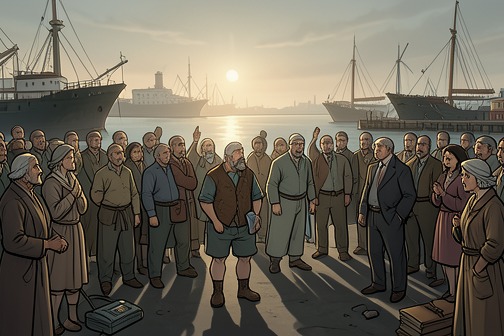
The [Anarres Famine](entity:event-recall-event-anarres-famine-5e4a3774727d) is a remembered crisis whose force in the novel lies not only in hunger but in the questions it leaves behind: how a society built on sharing responds when there is not enough, and whether solidarity can survive unequal access to food and transport. Its memory recurs in scenes of public protest and later shortages, making famine a test of social arrangements rather than a simple measure of scarcity.
## Memory and Political Background
Years later, the sight of a crowd standing outside the [Port of Anarres](entity:location-recall-location-port-of-anarres-6d3478c40bba) recalls how people had once gathered at produce-train stations during the Famine. The resemblance frightens the Defense foreman, who had expected the routine at the gate to remain uneventful. The memory gives the waiting crowd a history: stillness itself can signal need and a gathering that has yet to find words or action.
The famine also sharpens political arguments over the trade that links [Anarres](entity:location-recall-location-anarres-8af77930b83c) to [Urras](entity:location-recall-location-urras-cc6169219e59). Anarresti debate whether to continue exchanging minerals for supplies, including food-producing strains and manufactured goods that local production cannot readily provide. One argument for maintaining the arrangement is that its economic benefit to Urras discourages invasion; its opponents see it as profitable commerce with propertarian powers. Seven generations of peace have not produced trust, and the remembered vulnerability of scarcity helps explain why dependence remains a charged question.
## Drought and the Limits of Provision
A later dry winter in [Abbenay](entity:location-recall-location-abbenay-98fb15d5f0b8) shows how environmental stress can endanger the food supply. Frozen dust blows through the streets, water is rationed, and water is directed to keeping holum plants alive. The plants provide food and clothing—leaf, seed, fiber, and root—for Anarres’s twenty million people, while food reserves have never been large. The city’s needs therefore depend on a closely connected system of water, cultivation, storage, and distribution; a shortage in one part of that system cannot be treated as an isolated inconvenience.
The novel distinguishes scarce resources from the decisions and infrastructure that determine who can reach them. During an emergency, transport is overwhelmed: provision trains take precedence, vehicles and workers are pressed into service, and an error on the line leaves a passenger train stranded after a wreck. The episode makes clear that food may exist elsewhere while those who need it remain unable to obtain it. The famine’s remembered significance thus extends beyond a natural shortage to the capacity of distribution networks and collective arrangements to withstand pressure.
## The Stranded Train and the Test of Sharing
At a mill town dependent on transport for food, 450 stranded passengers have gone without breakfast, while the town’s 160 residents have no surplus in their commons or warehouses. The residents give the travelers nothing. Sharing the available food, the account explains, might leave the town itself without provisions for days, with no certainty about when the next train will arrive or how much grain it will carry. The decision is not presented as effortless selfishness: the arithmetic of need places two vulnerable groups in direct conflict.
The passengers fast for sixty hours before reaching a station with a stocked refectory. For [Shevek](entity:character-recall-character-shevek-c03b61cb02ce), this is his first experience of hunger as an involuntary condition: he had sometimes skipped meals while working, but food had always been available. As the train waits beside a quarry and a shut-down mill, he considers whether Anarresti society can endure famine without losing the solidarity on which it rests. When there is enough, even barely enough, sharing is possible; when there is not, force and power threaten to take its place, aided by the choice to look away.
The passengers’ resentment grows, and some seriously propose raiding the town’s truck gardens. Yet the train eventually moves, and at the next station the travelers receive half a loaf of holum bread and a bowl of soup. Their relief gives way to laughter and conversation: they have got through the ordeal together. The episode holds both outcomes in view—the temptation to seize food and the renewed fellowship that follows shared hardship—without treating either as proof that solidarity is automatic.
## Social Consequences and Significance
A driver later invokes hungry children and food passing through that was not meant for them to explain how hunger can provoke people to mob trains. He also recalls an episode in which a man responsible for a train put it into reverse while people were taking it apart, without stopping to count who might be affected; afterward, the man was ill at what he had done. The driver distinguishes such actions under desperate pressure from assigning someone the deliberate responsibility of deciding who lives and who dies. His account frames famine as a moral and institutional danger: scarcity can make desperate acts understandable, but it does not make every form of authority over life acceptable.
Taken together, these recollections make the Anarres Famine a continuing measure of the society’s promises. Ecological limits, weak reserves, and transport failures create real hardship; the crucial question is how people distribute risk and respond to one another when ordinary provision breaks down. The novel neither assumes that mutual aid will always prevail nor reduces famine to population pressure alone. It shows solidarity as a practice that must be sustained under material constraint, and exposes the violence that can enter when need is met with exclusion, coercive decisions, or deliberate indifference.
Event 5
Afforestation of the West Temaenian Littoral
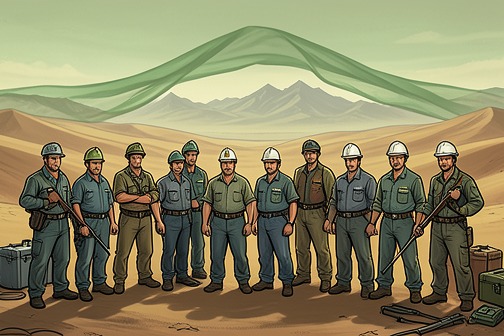
The [Afforestation of the West Temaenian Littoral](entity:event-recall-event-afforestation-of-the-we-287a404abd2b) was a major Anarresti restoration project that sent planting crews into the Dust to re-establish forest on land dried by millennia of drought. Conducted over two years in the fifteenth decade of the [Settlement of Anarres](entity:event-recall-event-settlement-of-anarres-cddedb63298d), it employed nearly eighteen thousand people. Its modest visible result—a faint green veil on desert terraces—joined ecological repair to the novel’s account of shared labor, environmental vulnerability, and the difficult work of reversing damage across generations.
## Landscape and ecological purpose
The project addressed a stark imbalance in [Anarres](entity:location-recall-location-anarres-8af77930b83c)’s geography. The fertile communities of the Southeast occupied only a narrow strip beside the sea; inland and westward, across the broad plains of the [Southwest](entity:location-recall-location-southwest-d3c7c47f662d), the Dust extended around a few isolated mining towns. That expanse was not barren by origin: in an earlier geological era it had been covered by holum forest, the planet’s ubiquitous dominant plant genus. A hotter, drier climate and millennia of drought killed the trees and reduced the soil to fine grey dust, which winds piled into barren, dune-like hills.
The planting effort therefore aimed not simply to put trees into a desert but to restore fertility to a damaged landscape. Anarresti hope rested on the possibility that land once shaded by forest might again support dark, rich soil. The undertaking made ecological repair a long, collective process: the harm had accumulated over millennia, while the work proceeded through human crews, seedlings, and years of labor.
## The work and its costs
Seedlings were raised in the Green Mountains, where rainfall reached as much as forty inches a year, and transported from the [Northeast](entity:location-recall-location-northeast-a7776fc34ac8) to the planting crews. [Shevek](entity:character-recall-character-shevek-c03b61cb02ce) worked with a crew planting thousands of the small trees in the Dust. At night, people in the project camps coughed; during the day, they coughed less because they were busy. The fine, dry dust obstructed their breathing, making the landscape both the obstacle they endured and the ground they hoped to restore.
The project’s scale became visible at the end of the second year. Fifty crews drove away in flatbed trucks, looking back at the pallid desert curves and terraces. They saw a very faint mist of green: a light veil of life laid over dead land. The crews cheered and sang from truck to truck, and Shevek was moved by the sight. The result was not a mature forest or a completed recovery, but the first visible sign that sustained collective effort might alter the Dust’s future.
## Meaning within Anarres’s wider conditions
For Shevek, the replanting suggested a connection between ecological restoration and [Causative Reversibility](entity:concept-recall-concept-causative-reversibili-b900e09753e2), an idea in temporal physics that he regarded as an intimate, tacit element of Odonian thought. He considered writing about the relationship between [Odo](entity:character-recall-character-odo-5a1f3aaae2aa)’s ideas, temporal physics, and the problem of ends and means, though at eighteen he judged himself not yet knowledgeable enough to do so. The project thus linked physical work on the land with his emerging scientific questions: what has been caused may, through action, be answered or counteracted.
That hope existed alongside Anarres’s material dependence on a precarious environment. The planet’s holum plants supplied food, clothing, and other necessities, while water during the later drought was directed toward keeping plants alive. [The Dust](entity:location-recall-location-the-dust-e9a16be4e5c1) project’s ambition to renew an old forest consequently belonged to a broader struggle over land, water, labor, and survival. The novel also situates Anarres within an unequal exchange with [Urras](entity:location-recall-location-urras-cc6169219e59): freighters brought fossil fuels, machine parts, and other supplies, while carrying away metals and uranium from what was, in economic terms, a mining colony. Against that extractive relation, afforestation represented a different use of collective labor—not the removal of mineral wealth, but an attempt to give damaged land back its capacity to sustain life.
## Legacy and narrative significance
The project’s achievement remains deliberately partial. The crews leave behind only a faint green trace, and the coughing, arid conditions make clear that intention alone cannot erase the consequences of a changed climate. Yet the image of the planted trees holds together hope and limitation: restoration is possible, but it demands time, shared work, and a willingness to bear present costs for a future not yet secured.
In the larger narrative, the afforestation episode gives physical form to the principle that ends and means are connected. The forest cannot be restored by declaration; it must be planted, crew by crew, in the very dust that frustrates the work. The project’s green veil is therefore both an environmental beginning and a social one, showing Anarresti solidarity at work while exposing how ecological vulnerability reaches into the bodies and daily labor of those who undertake repair.
Event 6
Shevek's visit to Urras
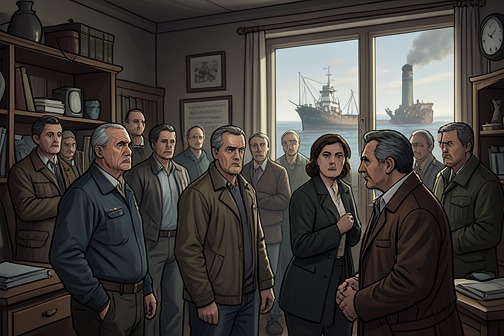
[Shevek's visit to Urras](entity:event-recall-event-shevek-s-visit-to-urras-6a016457fa39) is both a physical crossing from [Anarres](entity:location-recall-location-anarres-8af77930b83c) and a political test of whether two isolated societies can meet without turning knowledge and hospitality into instruments of possession. He arrives acclaimed as a scientist, but carries no money and refuses to treat his dependence on his hosts as an ordinary transaction. The visit's decisive movement is from bargaining with a profit economy to rejecting exclusive control: [Shevek](entity:character-recall-character-shevek-c03b61cb02ce) wants his theory to be a gift shared among worlds, not a source of power for one government.
## Departure and Arrival
On the [Mindful](entity:object-recall-object-mindful-d42272acac89), the ship's hurried launch routines leave Shevek strapped into the crew lounge with the doctor, watching the departure on a screen. The field and the wall around it rush dazzlingly downward; the forces of liftoff press his head back, make him sick, and provoke a bodily fear that his conscious purpose cannot simply master. The departure is therefore not an abstract passage between planets but a violent threshold experienced in the body.
The landing repeats that threshold in reverse. Groggy after immunizations, Shevek hears orders through the wall speaker and is carried from his bunk into a crowded officers’ lounge, where he concentrates on standing, walking, and shaking hands while names and voices pass around him. He does not know the ship has landed until the screen that had shown [Urras](entity:location-recall-location-urras-cc6169219e59) is blank. Stepping off the covered ramp, he stumbles; in the instant between beginning and completing the step, he thinks of death, then finds himself standing on a new earth.
The new world is at once unfamiliar and recognizable. In the cool, damp evening air, Shevek recognizes the air as that of the world from which his race came, and as home. Yet the public scene immediately converts his arrival into an image: photographers film the tall physicist among dignitaries, professors, and security agents, while journalists are kept at a distance. The news presents him as the First Man from the Moon, even as the grief and recognition on his face resist the celebratory spectacle.
## The Beggarman and the Gift of Hospitality
Shevek arrives without luggage or money. His bleached, slightly shrunken suit still fits, and its familiar holum-fiber texture helps him feel himself again. He explains the practical and ethical problem to the doctor: because he cannot buy food, and could not bring enough to sustain himself, keeping him alive requires that others give to him. He calls himself the Beggarman, turning his dependence into a direct encounter between Anarresti sharing and Urrasti purchase.
That principle recurs when [Saio Pae](entity:character-recall-character-saio-pae-cb09f7ef752b) arranges for a servant to bring clothing. Shevek tells [Atro](entity:character-recall-character-atro-c3f8853511b4) that he came with empty hands: he could bring neither money nor gifts, and his society uses nothing that Urras lacks. Atro and Pae assure him that he is an honored guest and that receiving care is their privilege; [Chifoilisk](entity:character-recall-character-chifoilisk-d42dce4ec0c0) cuts through the benevolent language by noting that the [Ioti Government](entity:organization-recall-organization-ioti-government-b90c6a0c2586) pays the bill. Pae's sharp glance and Chifoilisk's unreadable expression leave the welcome shadowed by the question of who controls its terms.
Shevek does not understand hospitality as a favor that ends the matter. His point is that he cannot keep himself alive through purchase, so the hosts must choose whether to give. The distinction matters throughout the visit: a society may call a visitor its guest while still treating his presence, labor, or knowledge as something funded for its own purposes. The Beggarman is not merely a figure of need; he exposes the assumptions concealed inside an apparently generous welcome.
## Learning Across the Wall
Shevek says that he came to learn, and asks for books—history, pictures, stories, even books for children. His education about Urras has concentrated mostly on the time of [Odo](entity:character-recall-character-odo-5a1f3aaae2aa); he knows little of the long period before the [Settlement of Anarres](entity:event-recall-event-settlement-of-anarres-cddedb63298d) and acknowledges the ignorance that followed the last settlers’ departure. Anarres ignores Urras, he says, and Urras ignores Anarres. He wants that mutual ignorance ended because a morality adequate to relations between worlds cannot remain tribal.
This purpose is not simply a wish to admire a beautiful planet. Shevek wants to know the society he has entered rather than accept a ready-made account of it, and he links ignorance to the wrongs that may grow from it. Pae enthusiastically agrees with his stated aims, while [Oiie](entity:character-recall-character-oiie-d6f7999b64d2) asks whether he has come essentially as an emissary of his society. The question makes visible a tension Shevek’s visit cannot evade: he is an individual seeking knowledge, but others can interpret him as the representative or instrument of a whole planet.
The news accounts quickly demonstrate that representation can become fabrication. A newspaper describes Shevek as a prize-winning scientist who has accepted a professorship at [Ieu Eun University](entity:organization-recall-organization-ieu-eun-a4eaab2e5a51) and prints a statement welcoming a new era of friendship between the Twin Planets. Shevek protests that he never said those words. Pae explains that the journalists had not been allowed near him and had invented what they wanted him to say. His arrival is thus mediated from the outset by public narratives that present him as a diplomatic emblem while substituting a convenient message for his own speech.
## Bargaining Against Profit
Chifoilisk eventually states the political danger plainly: [A-Io](entity:location-recall-location-a-io-fcd52e3420b2) gives Shevek comfortable rooms, lectures, students, money, and access because it is a profit economy, not out of scientific disinterest or brotherly love. Shevek answers that he knows this and came to bargain with it. His purpose is not to secure a private advantage. He wants his people to come out of exile and seeks free exchange between Urras and Anarres; he believes A-Io fears him less than [Thu](entity:location-recall-location-thu-cf94fc430d08) because A-Io has forgotten the revolution and expects possession to make people content in their confinement.
The terms of that bargain become clearer when Shevek later confronts the possibility that his pursuit of physics has betrayed the idea of freedom, change, and human solidarity that formed him. He sees that he is allowing the propertarians to buy the truth from him. His response is to ask whether selling is the only possible relation and whether a gift can exist instead. The question reverses the logic of his hosts’ welcome: if knowledge is treated as property, its circulation can serve those able to purchase and control it.
Shevek specifies the alternative. He wants to give his theory to [Keng](entity:character-recall-character-keng-aa9da29f851b), to [Hain](entity:location-recall-location-hain-aee202d20a49), to the other worlds, and to the countries of Urras—not to one recipient who could use it to gain power over others, grow richer, or win wars, but for the common good. Keng answers that truth usually insists on serving the common good eventually. Shevek refuses to wait for that eventuality: one lifetime is all he has, and he will not spend it in the service of greed, profiteering, and lies. His refusal to serve any master turns theoretical sharing into a concrete political choice.
## The Visit as a Test of Contact
Across the visit, the same contradiction appears in different forms. Shevek is welcomed as an honored guest, but his expenses are paid by a government; hailed as a messenger of friendship, but misquoted by newspapers; invited to exchange knowledge, but brought into a system that can convert knowledge into advantage. The visit makes contact possible without making it innocent. Every offer of access raises the question of whether it enables mutual understanding or places Shevek inside another society’s machinery of influence.
The journey’s physical images give that question its shape. At departure, the wall and the landscape fall away beneath the force of the ship; at arrival, a single unsteady step brings Shevek onto a world whose air feels both foreign and ancestral. The crossing does not erase the separation between societies. It makes the separation newly perceptible, and tests whether it can be answered by more than spectacle, profit, or official representation. Shevek’s proposed answer is an unpossessed gift: knowledge freely shared, so that the worlds may meet without one making a private instrument of the truth.
Event 7
本比利革命
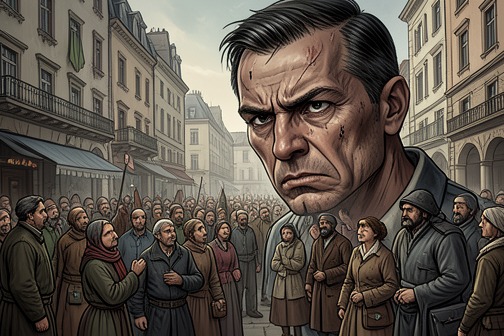
[The Benbili Revolution](entity:action-recall-action-benbili-3d1f5060777b) begins as news from a poor, distant country and becomes a measure of the gap between political language and political action. The rebels’ seizure of the capital and release of prisoners awaken hope in [Shevek](entity:character-recall-character-shevek-c03b61cb02ce); [A-Io](entity:location-recall-location-a-io-fcd52e3420b2)’s armed intervention turns that hope into revulsion and places the uprising within the rivalry between A-Io and [Thu](entity:location-recall-location-thu-cf94fc430d08). The crisis also brings wartime restrictions closer to Shevek’s own life, showing that the supposedly orderly world of [Urras](entity:location-recall-location-urras-cc6169219e59) can confine outsiders and control knowledge as readily as it can project force abroad.
## Causes and Political Background
The news arrives in emphatic headlines announcing that revolutionaries hold the capital and the dictator has fled. The popular papers render events in an excited, compressed idiom, with spelling and grammar giving way to an unstable present tense. Their voice contrasts with the brief, dry official reports. Shevek looks up [Benbili](entity:location-recall-location-benbili-2a2ba6b23b5b) in an encyclopedia: formally a parliamentary democracy, it is in practice a military dictatorship run by generals. It is a large, poor, underpopulated country of mountains and arid savannahs. The uprising is thus presented through two competing registers—official summary and popular urgency—before its stakes become clear to him.
The rebels hold Meskti, Benbili’s capital, while the retreating army burns fields and towns. Guerrillas harry the army, and the revolutionaries open the jails, granting amnesty to the prisoners. President-General Havevert escapes in his armored airplane; some lesser generals are captured and subjected to emasculation, a punishment traditionally preferred in Benbili to execution. These details make the revolution more than a change of leadership: the rebels challenge the military order, release those it imprisoned, and confront an army willing to devastate its own country as it retreats.
## A-Io’s Intervention and Shevek’s Response
Shevek follows the reports with growing intensity. The release of the prisoners makes his heart leap; in the distant revolt he sees that hope remains possible. On the fourth day, however, a broadcast of debate in the [Council of World Governments](entity:organization-recall-organization-council-of-world-0f75bde759d9) brings a reversal. The Ioti ambassador announces that A-Io is sending armed reinforcements to President-General Havevert, claiming to support Benbili’s democratic government. The justification sits uneasily beside the account of a military dictatorship and a popular rebellion against it.
The imbalance in force sharpens the reversal. The revolutionaries are mostly unarmed, while the Ioti arrive with guns, armored cars, airplanes, and bombs. Reading about that equipment, Shevek feels sick; his hope for the rebels becomes anger at the threat they face. He has no one around him with whom he can speak freely. [Atro](entity:character-recall-character-atro-c3f8853511b4) is an ardent militarist, and [Oiie](entity:character-recall-character-oiie-d6f7999b64d2)’s attachment to property and law and order leads him to explain the conflict as a struggle between A-Io and Thu rather than as a question of who governs Benbili. Oiie argues that the rebels are learning that freedom without weapons cannot defend itself. Shevek repeats Oiie’s phrase, “The politics of reality,” and notes its strangeness coming from a physicist: the phrase treats power as the decisive reality while pushing the Benbilis’ political agency to the margins.
## War, Restrictions, and Political Power
A-Io’s intervention also changes the conditions under which Shevek lives and works. Oiie explains that the two rival powers will not invade each other, but calls the military action in Benbili a police action that maintains the balance of power. Although the states are officially at war, he presents the consequences on Urras as manageable: research at the College of Noble Science is subject to classification, publication may be delayed if officials consider a paper dangerous or incomprehensible, and non-nationals such as Shevek are not supposed to leave the campus without the Chancellor’s clearance. Oiie offers to get him around the restrictions. His casual confidence in evading the rules does not undo the fact that wartime authority has restricted research and movement.
The episode resonates with the institutions Shevek has already encountered on [Anarres](entity:location-recall-location-anarres-8af77930b83c), though the mechanisms differ. There, administrative coordination has required a center in [Abbenay](entity:location-recall-location-abbenay-98fb15d5f0b8), and the settlers recognize centralization as a continuing threat that demands vigilance. Shevek has also found that [PDC](entity:organization-recall-organization-pdc-0178fd73f7f5) port managers can stop letters to Urrasti scientists: mathematicians’ correspondence is suspected of being coded, and letters to physicists require [Sabul](entity:character-recall-character-sabul-4d1d4a30ffd4)’s approval. In his argument with [Bedap](entity:character-recall-character-bedap-725a11cb5594), the danger is not a formal government but a social power that can suppress ideas by ignoring them and denying their authors the chance to publish, teach, or work. Against those experiences, the Urrasti response to war makes coercion more visible and official: classification and campus restrictions are attached to the state of war, even as personal connections offer ways around them.
## Aftermath and Significance
The novel’s later scenes place the Benbili intervention beside other forms of political force without making them identical. In [Capitol Square](entity:location-recall-location-capitol-square-89b6f4ddb428), an immense crowd gathers, marches, sings, and listens to speakers before helicopters drown out the words with gunfire. The violence makes the fragility of public assembly and political speech unmistakable. At the Terran embassy, the envoy tells Shevek that he has a right to be there because the embassy represents the Council of World Governments, not A-Io, and that the castle is Terran soil. Elsewhere, the closure terms for the Anarres settlement are invoked to state that arrivals from Urras may not leave the freight ships beyond the port boundary. Across these different situations, political authority appears through control of weapons, territory, access, and movement.
The Benbili uprising therefore functions as more than a foreign crisis in the background of Shevek’s visit. Its changing fortunes expose the distance between A-Io’s claim to defend democracy and the armed support it gives a fleeing military ruler, while Oiie’s account reduces a rebellion to the strategic balance between rival powers. For Shevek, the rebels’ vulnerability makes the political stakes bodily and immediate: freedom is not secured merely by naming it, yet force deployed in its name may serve the interests of states rather than the people whose freedom is at stake. The episode deepens his estrangement from Urras’s assurances of political realism and prepares the moral contrast between popular hope and the machinery sent to contain it.
Event 8
A-Io intervention in Benbili
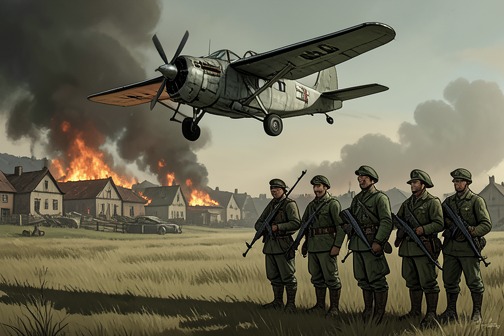
[A-Io’s intervention in Benbili](entity:action-recall-action-benbili-f68694e1fece) is a military operation presented as support for the country’s government, but it places armed state power against a revolution whose partisans are mostly unarmed. The episode sharpens [Shevek](entity:character-recall-character-shevek-c03b61cb02ce)’s conflict with [Urras](entity:location-recall-location-urras-cc6169219e59)’s political order: where its defenders describe power as realism, he sees the destruction of freedom—and later carries that opposition into a public confrontation with the state itself.
## Causes and Political Justification
[Benbili](entity:location-recall-location-benbili-2a2ba6b23b5b) is a poor, underpopulated country of mountains and arid savannahs. Though formally a parliamentary democracy, it is in practice a military dictatorship governed by generals. A revolution breaks out, and reports from its capital, Meskti, describe rebels advancing against the army. President-General Havevert escapes in his armored airplane; retreating government forces burn fields and towns, while guerrillas harry them. The revolutionaries open the jails and grant amnesty to the prisoners.
On the fourth day of the revolt, Shevek watches a debate in the [Council of World Governments](entity:organization-recall-organization-council-of-world-0f75bde759d9). [A-Io](entity:location-recall-location-a-io-fcd52e3420b2)’s ambassador announces that the country is sending armed reinforcements to support Havevert, describing the action as assistance to Benbili’s democratic government. Yet the intervention aligns A-Io with a president-general whose government is, in practice, a military dictatorship. The claim of democratic support therefore sits uneasily beside the power the operation is meant to restore.
A-Io’s stated justification is also strategic. [Oiie](entity:character-recall-character-oiie-d6f7999b64d2) tells Shevek that A-Io and [Thu](entity:location-recall-location-thu-cf94fc430d08) will not invade each other directly, but are officially at war and will fight in Benbili. He calls this kind of intervention a way of maintaining the balance of power. In his account, the conflict is not principally about who governs the Benbilis; it is part of the struggle between A-Io and Thu. Benbili becomes the ground on which rival states exercise power while avoiding war on their own territory.
## The Unequal Encounter with Force
The revolutionaries are mostly not even armed. A-Io’s reinforcements, by contrast, come with guns, armored cars, airplanes, and bombs. Reading the descriptions of that equipment, Shevek feels sick. The contrast is not simply between two armies of different size: it is between a popular revolt and the machinery of an established state arriving under the name of support.
The retreating army’s burning of fields and towns and the revolutionaries’ opening of prisons make the struggle’s stakes concrete. Against that destruction, the amnesty offers Shevek a moment of hope. But the arrival of A-Io’s forces changes the meaning of the rebellion in his eyes: the question is no longer only whether Benbili’s people can overthrow their rulers, but whether their attempt at freedom can withstand intervention by a state with overwhelming military resources.
## Shevek’s Response and Political Conflict
Shevek follows the distant revolution with growing intensity, despite having rarely used the radio after discovering that it chiefly advertises goods for sale. Official reports are brief and dry; popular papers print Revolution! across their pages. The competing forms of news make the intervention visible in different registers: as controlled political information and as an event capable of stirring public feeling. For Shevek, the reports cease to be remote. He thinks he should have gone to Benbili and imagines its pale plains and wind, while the prospect of the armed intervention leaves him physically ill.
He has no comfortable confidant in Urras. [Saio Pae](entity:character-recall-character-saio-pae-cb09f7ef752b) is out of the question, [Atro](entity:character-recall-character-atro-c3f8853511b4) is an ardent militarist, and Oiie’s personal regard for Shevek does not free him from the property owner’s attachment to law and order. Oiie treats the Benbili rebels as people learning that freedom without guns cannot defend itself. Shevek responds to the phrase with irony: calling the politician’s account of force the “politics of reality” sounds strange coming from a physicist. Oiie insists that both politicians and physicists deal with real forces and basic laws. Their exchange brings the intervention’s central disagreement into focus: whether power is an unavoidable law of political life, or a force whose dominance should itself be challenged.
## War, Control, and the Wider Stakes
The declaration that A-Io is officially at war has consequences beyond Benbili. Oiie explains that wartime rules will bring research in the College of Noble Science under classification, delay publication when authorities suspect a paper they do not understand, and limit travel—especially for non-nationals. Shevek is not supposed to leave the campus without the Chancellor’s clearance, though Oiie offers to help him evade the restrictions. The intervention thus reveals how military conflict can extend state control into scientific work and personal movement, even for someone not fighting in Benbili.
Later, the Terran ambassador interprets the violence in [Nio Esseia](entity:location-recall-location-nio-esseia-f772168c8bdc) partly through the precedent of Benbili. He recognizes that the revolutionaries there belong to the same libertarian tradition and argues that the scale of the demonstration and the government’s panic response become more intelligible in that light. The comparison places A-Io’s intervention within a broader political pattern: the state treats a challenge to power not merely as a dispute over wages or policy, but as a danger capable of spreading.
## From Intervention to Public Confrontation
The intervention’s logic resonates in the Nio Esseia demonstration, where a vast crowd gathers in [Capitol Square](entity:location-recall-location-capitol-square-89b6f4ddb428) to hear Shevek speak. He presents solidarity not as a gift bestowed by rulers but as something people must make together, and sets mutual aid and free association against governments, armies, and war. His speech insists that freedom cannot be bought or delivered by someone else; it must be lived by those who seek it.
The police helicopters drown out his voice, and machine-gun fire is directed at the people nearest the Directorate’s steps. The contrast between collective speech and armed force gives the Benbili episode a later echo: military power again answers a gathering of people acting together. In the wake of the shooting, the Terran ambassador recognizes the connection between the [Nio](entity:location-recall-location-nio-85927403d9aa) revolutionaries and the libertarian tradition associated with [Anarres](entity:location-recall-location-anarres-8af77930b83c). What began for Shevek as news of distant Benbili has become part of a wider confrontation over whether organized violence can contain the demand for freedom.
## The Intervention and Anarres’s Political Boundary
On Anarres, the question of contact with Urras raises a related fear. At a meeting, [Rulag](entity:character-recall-character-rulag-f4723d9ee7ed) argues against admitting visitors, warning that an opening could lead from a few arrivals to profiteers and then an armed occupation. She invokes the Settlement’s restriction on Urrasti leaving their ships as protection for the society’s survival. [Bedap](entity:character-recall-character-bedap-725a11cb5594) counters that contact would signal confidence rather than weakness, while Shevek distinguishes the proposal to receive visitors from an individual’s right to travel to Urras.
When Shevek argues that Anarresti should not be made subjects of majority rule, he identifies revolution as an ongoing responsibility rather than a settled guarantee of safety. Rulag answers that his choice risks involving everyone in dangers driven by private motives. The Benbili intervention lends weight to that dispute without resolving it: it demonstrates the danger of armed states intervening in weaker societies, while leaving open how a society founded on freedom should respond to that danger without turning its own protections into authority.
Event 9
Nio Esseia Insurrection (Ninth Month Strike)
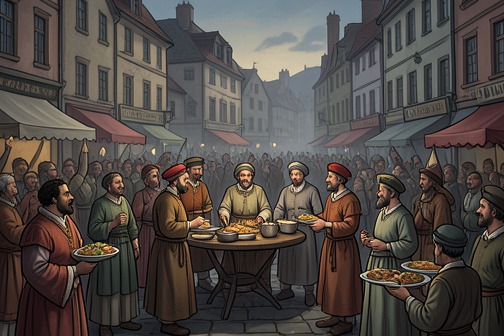
The [Nio Esseia Insurrection (Ninth Month Strike)](entity:event-recall-event-nio-esseia-insurrection-b674fa80812e) was the uprising led by [Odo](entity:character-recall-character-odo-5a1f3aaae2aa) in [Nio Esseia](entity:location-recall-location-nio-esseia-f772168c8bdc) in the Urrasti year 740, an event whose significance reaches beyond its place in the past. On [Anarres](entity:location-recall-location-anarres-8af77930b83c) it is remembered in a midsummer festival honoring the workers whose strike helped set it in motion; on [Urras](entity:location-recall-location-urras-cc6169219e59), its example gives later dissidents a language for challenging war, inequality, and state power. Its enduring question is whether a revolution can ever be considered finished.
## Origins and Commemoration
The insurrection began with a strike led by a syndicate of cooks and waiters. Nearly two centuries later, Anarres marks it with [Insurrection Day](entity:time-recall-time-insurrection-day-62c534ea4b17), a midsummer holiday observed through a street festival and communal feast. Cooks and refectory workers are honored as the day’s guests, reversing the usual relation between those who prepare food and those who eat it. The ritual keeps the labor behind collective life visible: the uprising is recalled not only as political history but through the workers whose action helped bring it about.
Insurrection Day sits alongside traditions with different origins. Some festivals were instituted by the Settlers; harvest homes and the Feast of the Solstice arose spontaneously from the planet’s work rhythms and the desire of people working together to celebrate together. The juxtaposition places the insurrection within Anarres’s broader practice of making shared observances, rather than treating political memory as separate from everyday communal life.
## A Revolutionary Example on Urras
The insurrection remains a point of reference for political opposition in Urras. When Maedda describes Nio Esseia as nearing a breaking point, he names the pressures behind the unrest: four hundred thousand unemployed people, rising food prices, increased taxes, and opposition to conscription and war. He calls for a general strike and mass demonstrations, comparing the moment to the [Ninth Month Strike](entity:time-recall-time-ninth-month-strike-7a9bace62bbf) that Odo led. His appeal is not simply for a repetition of the past; he stresses that the present has no moon that can be offered to buy the protesters off, and insists that justice must be made where they are.
Maedda also explains why Anarres matters to people organizing against the existing order. For a century and a half, its existence has served as proof that a society without government, police, or economic exploitation is not merely an unattainable ideal. The remembered insurrection and the continuing existence of Anarres reinforce one another: Odo’s uprising offers a precedent for action, while the society founded by the Settlers demonstrates that a different social arrangement can endure.
## History Reopened as a Present Conflict
On Anarres, the anniversary’s celebratory form coexists with disagreement about what revolutionary freedom requires. In a meeting about contact with Urras, [Rulag](entity:character-recall-character-rulag-f4723d9ee7ed) invokes the Terms of the Closure of the Settlement to argue that no one may go farther than the boundary of the [Port of Anarres](entity:location-recall-location-port-of-anarres-6d3478c40bba) when arriving from a freight ship. She treats that restriction as protection against renewed domination. [Bedap](entity:character-recall-character-bedap-725a11cb5594) and [Shevek](entity:character-recall-character-shevek-c03b61cb02ce), by contrast, challenge the assumption that collective safety should settle every question of individual action.
Shevek argues that the Settlers came to Anarres for freedom, not safety, and that a society requiring everyone to agree and work in the same way risks becoming machine-like. In his account, revolution is not a secure achievement preserved by rules: it is an ongoing responsibility to initiate action, accept responsibility, and keep society capable of change. His appeal makes the memory of Odo’s insurrection more than an anniversary story. It turns that past into a test of whether Anarres still lives by the freedom its founding struggle was meant to establish.
Event 10
Anarres Drought and Famine
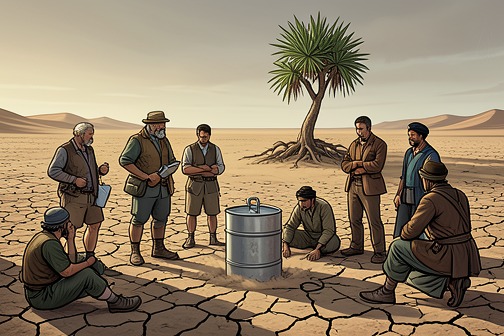
The [Anarres Drought and Famine](entity:event-recall-event-014c22b9d121) is a prolonged ecological and social crisis that tests whether [Anarres](entity:location-recall-location-anarres-8af77930b83c) can preserve mutual aid when the conditions for sharing break down. Beginning in 163 and still intensifying in 164, the drought exposes the connection between the planet’s fragile soils, its dependence on holum plants, and the transport and labor networks that distribute food. The famine does not simply reveal too little food: it forces difficult choices about whose needs count, who must work, and whether solidarity can endure when communities fear they have nothing left to give.
## Ecological and Economic Background
Anarres’s vulnerability predates the emergency. [The Dust](entity:location-recall-location-the-dust-e9a16be4e5c1), a vast inland region stretching westward across the plains of [Southwest](entity:location-recall-location-southwest-d3c7c47f662d), had once been covered in holum forest. A hotter, drier climate and millennia of drought killed the trees and reduced the soil to fine grey dust, leaving the region largely uninhabited apart from isolated mining towns. Replanting the forest was intended to restore the land’s fertility, but that long-term undertaking could not quickly remove the immediate dependence on limited arable areas and water.
The planet’s economy also tied Anarres to a trade relationship its inhabitants regarded with suspicion and humiliation. Urrasti freighters arrived only eight times a year, bringing fossil fuels, petroleum products, specialized machine and electronic parts, and occasional new strains of crops for testing. In return, they carried away large mineral shipments, including mercury, copper, aluminum, uranium, tin, and gold. Anarresti critics objected to doing business with propertarian powers, while defenders of the agreement argued that trade cost the Urrasti less than invasion would. Seven generations of peace had not produced trust. The arrangement’s strategic logic did not, however, amount to food security: Anarres had little reserve food, and during the drought the survival of regions depended heavily on internal transport.
## The Emergency and Its Uneven Burdens
The drought began in the summer of 163 and brought no relief in winter. By the summer of 164, hardship had become severe and the prospect of disaster was growing. Rationing tightened and labor drafts became imperative as people struggled to grow enough food and move it where it was needed. In [Abbenay](entity:location-recall-location-abbenay-98fb15d5f0b8), water for baths was strictly rationed because water had to be reserved for plants. Food and clothing for the planet’s twenty million inhabitants came from holum, but food stocks had never been substantial. The dust-filled, cloudless sky and frozen, dry winter made the crisis visible in the city as well as in the agricultural regions.
The transport system, normally adaptable and supported by regional self-organization, could not meet the demands placed upon it. Provision trains took priority, emergency workers were recruited from apprentices, retirees, volunteers, and draftees, and all available vehicles were pressed into service. Still, there were not enough vehicles or operators. The strain was not merely logistical: delayed food meant that the survival of whole regions could depend on transport schedules, while emergency labor diverted people from other necessary work.
The burden also fell unevenly through rationing rules. In one account of worklisting in [Elbow](entity:location-recall-location-elbow-97bb7a802c65), workers in the mill plant received full rations, while those on half-time received three-quarters and people too sick or weak to work received half. A worklister assigned to make these lists was himself working long hours at a desk and received full rations for his labor. He described his duty as making lists of who should starve, then quit and went to [Grand Valley](entity:location-recall-location-grand-valley-73376fb251d3). His departure did not end the practice: someone else took over the lists. The episode exposes how administrative categories could turn scarcity into a decision about which sick people might remain alive but be unable to recover enough to work again.
## The Stranded Train and the Test of Solidarity
During the emergency, [Shevek](entity:character-recall-character-shevek-c03b61cb02ce)’s train moved in short bursts and long waits because provision trains had precedence. After a dispatch error and a wreck farther along the line, it stopped for twenty hours in a small mill town that had no surplus food. The town’s 160 residents depended on transport themselves; the 450 passengers depended on the stalled train and the route beyond it. Giving the travelers food could leave the town without provisions for days, so the townspeople gave them nothing. The passengers, who had already missed breakfast, went without food for sixty hours before the train reached a station with a stocked refectory.
For Shevek, it was his first experience of hunger. He had sometimes chosen not to eat while working, but had never lacked access to two meals a day. The prolonged wait changed scarcity from an abstraction into a question about conduct. He wondered whether Anarres could endure famine without losing the solidarity on which its society depended. Sharing seemed straightforward when there was enough, even barely enough, to go around; under conditions of absolute shortage, force, power, and violence could take the place of mutual obligation, while people avoided looking at those they left without help.
The passengers’ anger at the town became bitter, and some seriously proposed raiding its truck gardens. Yet their resentment did not erase the townspeople’s own precarious position: feeding 450 travelers might have left 160 residents without food. When the train finally reached a station and the passengers received a half loaf of holum bread and a bowl of soup, the shared meal changed their mood. They returned to the train laughing and joking, relieved that they had endured the ordeal together. The episode neither proves that solidarity is effortless nor makes the town’s refusal harmless; it shows how quickly the ethic of sharing encounters the arithmetic of need when there is not enough for everyone.
## Ethical Conflict and Slow Recovery
The famine also raises the question of whether people may be required to make decisions that determine who eats. A driver recalls a grain-train syndic who reversed his train when hungry people tried to seize a grain truck, killing some of them. The driver recognizes the competing stakes: the grain was meant for hundreds waiting elsewhere, and the syndic acted amid an immediate threat to the train. He nevertheless doubts that human lives can be added up like numbers. His judgment is sharper about ration-list work: asking someone to decide which sick people receive half rations is, he argues, a task no person has the right to assign to another. In his view, mills should have been closed rather than making a worker administer such a choice. The crisis thus exposes competing failures—violence in defense of supplies and impersonal procedures that allocate deprivation—without making either choice easy.
The drought eventually broke in the winter of 167, but that change did not restore ordinary life at once. In the third quarter of 168, many people were still working long emergency shifts. Food had become adequate for the work expected of them, unlike in the preceding years, yet skilled workers still faced long postings and short commons. The distinction between the weather’s turning and the society’s recovery matters: the end of the drought did not immediately replenish reserves, normalize labor, or undo the exhaustion created by years of scarcity.
The event’s significance lies in this gap between a society’s principles and the conditions under which they must operate. Anarres’s food crisis grows from ecological limits and inadequate reserves, but its consequences are mediated by water allocation, transport capacity, labor assignments, and rationing decisions. The stranded train makes the central problem intimate: when a community cannot feed everyone, solidarity is tested not as an ideal but as a choice with costs. The famine exposes the vulnerability of Anarres without reducing the crisis to a simple contest between benevolence and selfishness; it shows how scarcity can pressure a culture of mutual aid toward exclusion, force, and accounting, while also making collective endurance newly meaningful.
Event 11
Publication of Principles of Simultaneity

The publication of [Principles of Simultaneity](entity:object-recall-object-principles-of-simultan-af7b4348baea) is a contested act of authorship and exchange: in early 164, [Shevek](entity:character-recall-character-shevek-c03b61cb02ce)’s work appeared in [Abbenay](entity:location-recall-location-abbenay-98fb15d5f0b8) as a drastically edited book bearing his name jointly with [Sabul](entity:character-recall-character-sabul-4d1d4a30ffd4)’s, while Shevek attempted to send the complete manuscript to [Urras](entity:location-recall-location-urras-cc6169219e59). The episode joins the immediate pressures of drought and political reputation to the novel’s larger question of whether knowledge is a possession to be controlled or a gift to be shared.
## Background: Institutions and the movement of ideas
[Anarres](entity:location-recall-location-anarres-8af77930b83c)’s decentralized society depended on extensive coordination. Because settlements were scattered across an arid world and relied on one another’s regional resources, the roads came first and the houses second; Abbenay became the necessary center for computers coordinating labor and distribution, as well as for the central federatives of many work syndicates. The settlers understood centralization as a lasting danger that required lasting vigilance. That tension frames the book’s passage through institutions: coordination can sustain a common life, but control over channels of communication can also restrict what people are able to think and publish.
Shevek had already encountered such restrictions in the circulation of his scientific work. Letters to physicists and mathematicians abroad could be stopped by the managers of the Port of Abbenay, who distrusted technical correspondence they could not verify. Letters to physicists required Sabul’s approval, and he withheld it when their subjects fell outside his own [Sequency](entity:concept-recall-concept-sequency-2760037f6c36) physics. Shevek’s appeals to the [Physics Federation](entity:organization-recall-organization-physics-federati-0bb0315849c0) did not make free communication with the ideological enemy a priority. By the time the book was printed, the problem was therefore not simply how to produce a theory, but who could authorize its movement and in what form.
## The abridged book and its political use
The first printed edition appeared in Abbenay early in 164, incomplete and drastically edited, with Shevek and Sabul named as joint authors. [PDC](entity:organization-recall-organization-pdc-0178fd73f7f5) was then printing only essential records and directives, but Sabul used his influence at the Press and in PDC’s Information division to argue for the book’s propaganda value abroad. Urras, he said, was taking satisfaction in Anarres’s drought and the possibility of famine; recent Ioti journals predicted the imminent collapse of the Odonian economy. Against those predictions, Sabul presented the publication as a monument of pure thought that would demonstrate the vitality of Odonian society despite material adversity.
That justification made the book serve two purposes at once. It was a work of physics, but its appearance was also enlisted as a rebuttal to Urrasti claims about the failure of Anarres. The institutional argument for printing it did not restore Shevek’s complete work: the version released under his name had been sharply cut, and Sabul’s influence determined the public form in which the theory could travel. The mismatch between the book’s claim to intellectual achievement and its edited contents makes publication itself part of the conflict over authority.
## The complete manuscript sent abroad
Fifteen of the edition’s three hundred copies went aboard the Ioti freighter [Mindful](entity:object-recall-object-mindful-d42272acac89). Shevek did not open a copy of the printed book. Instead, he placed a handwritten copy of the original, complete manuscript in the export packet, addressed to Dr. [Atro](entity:character-recall-character-atro-c3f8853511b4) at the College of the Noble Science of [Ieu Eun University](entity:organization-recall-organization-ieu-eun-a4eaab2e5a51), with the author’s compliments. The gesture offered a different route for the work: not the abridged text promoted as a public emblem, but the complete argument sent directly to a physicist abroad.
Shevek could not know whether the manuscript would reach its destination. Sabul gave final approval to the packet and might remove it out of spite, or allow it to go because the abridgment would not persuade Urrasti physicists. He said nothing about the added manuscript, and Shevek did not ask. Thus the printed edition’s limited circulation and the uncertain fate of the complete text remain joined: the attempt to share the work is concrete, but the passage through official channels leaves its success unresolved.
## Authorship, exchange, and the novel’s larger conflict
The publication episode echoes Shevek’s earlier insistence that he had come to Urras without money or gifts and could only receive what others chose to give. He describes himself as the Beggarman, an Anarresti in a world where things must be bought, and later tells [Chifoilisk](entity:character-recall-character-chifoilisk-d42dce4ec0c0) that he has come to bargain with a profit economy for free exchange and human solidarity between Urras and Anarres. The book’s compromised appearance gives that political tension an immediate institutional form: the work crosses borders, but its public version is shaped by those who control its printing and export.
Later, Shevek names the alternative he wants: the gift. He says he wants to give his theory to Urras, [Hain](entity:location-recall-location-hain-aee202d20a49), and other worlds so that no state can use it to dominate others, enrich itself, or win wars, but so it may serve the common good. Read against that later offer, the complete manuscript placed in the Mindful’s export packet is an early, uncertain enactment of the same principle. Publication does not resolve the contest between common knowledge and controlled property; it shows how even a scientific work can become a site where that contest is fought.
Event 12
薛维克逃离大学并加入地下反抗者
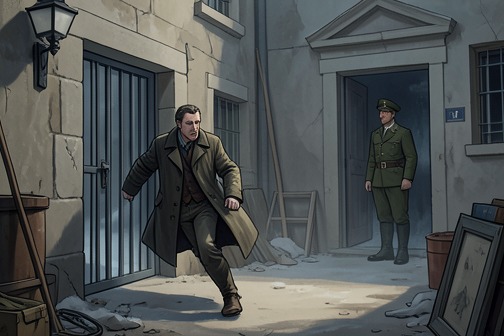
[Shevek](entity:character-recall-character-shevek-c03b61cb02ce)’s escape from the University and entry into the [Urras](entity:location-recall-location-urras-cc6169219e59) underground opposition turn his private refusal of state control into public political action. With [Efor](entity:character-recall-character-efor-2a84f491a8fc)’s help, he slips away from the restricted campus to seek [Tuio Maedda](entity:character-recall-character-tuio-maedda-161dfaeb121e), then proposes to write for the opposition press: rather than disappear, he will make his presence known and put his account of [Anarres](entity:location-recall-location-anarres-8af77930b83c) and his refusal to sell his work before the people of [A-Io](entity:location-recall-location-a-io-fcd52e3420b2).
## Background: A World of Scarcity and Control
By the winter of Shevek’s departure, Anarres is living through a severe drought. The cold, dry season arrives early in the Northern Hemisphere; frozen dust sweeps through [Abbenay](entity:location-recall-location-abbenay-98fb15d5f0b8), baths are strictly rationed, and water is directed toward the holum plants that supply food and clothing for Anarres’s twenty million inhabitants. There is little reserve food. Against this material vulnerability, Shevek’s insistence on individual initiative is not an abstract preference: his society’s commitments to sharing and collective provision are being tested by scarcity and emergency.
His immediate predicament on Urras is different but no less constraining. He has come from Anarres to pursue scientific work and publication, yet discovers that the government treats an idea as state property. He refuses the money and material advantages attached to that arrangement. At the same time, he has been forbidden to leave the University campus, and fears that the authorities will stop him if he boards a train. His decision to seek the opposition therefore follows from two refusals: he will not submit his theory to state ownership, and he will not accept confinement as the price of remaining in Urras.
## Efor’s Warning and the Escape
Efor understands the danger before Shevek does. He warns that the government wants Shevek and that the opposition needs him, but that a conspicuous outsider cannot easily hide: wherever he goes, he risks being caught and shot. Efor has been approached before about helping the underground, but has kept his distance. He explains that he has come to admire Shevek and does not want him drawn into dangers that he may not understand; he would rather see him return to the people he regards as free.
Shevek answers that he cannot go back yet and wants to meet the opposition. Efor finally gives him a contact: Tuio Maedda, who can be found at a grocery in [Joking Lane](entity:location-recall-location-joking-lane-b217c017de23), in [Old Town](entity:location-recall-location-old-town-662418b2ff4a). When Shevek says that [Saio Pae](entity:character-recall-character-saio-pae-cb09f7ef752b) has forbidden him to leave the campus, Efor considers a taxi rather than the train. He offers to pack a bag, but Shevek questions the need for one and remembers that he should take his money. The details reveal how little the escape resembles a prepared flight: Shevek is moving before he has settled what to carry or where he will go.
Efor calls a taxi and directs Shevek to avoid the main gate, where he would certainly be stopped. Instead, he is to leave by the stairs and meet the driver at the back door, then take Grove Road, which has no checkpoint. The two men whisper. Shevek asks whether Efor will be blamed for helping him; the question makes the servant’s personal risk part of the escape, not merely its logistics. The flight depends on Efor’s judgment and on a route through the city that avoids the institution’s most visible controls.
## Finding the Opposition
At Maedda’s office, Shevek arrives still wearing his coat. He is exhausted enough to shake and describes the University as both campus and jail. He has come to the working classes because he thinks they may be people who help one another; he does not yet know where to turn or what kind of help to request. The encounter relocates his search from the institution that claims his labor to a political circle whose solidarity he hopes may be real.
Shevek tells Maedda that he has an idea—a scientific theory—and came to Urras believing he could work and publish it. He did not understand that the State would claim it as property. He says that he does not work for a State, cannot take its money and goods, and wants to get out, though he cannot go home. His explanation makes the conflict over scientific publication inseparable from the immediate question of refuge: he is not simply trying to evade arrest, but trying to find a way of acting without surrendering the principles that brought him to Urras.
The opposition’s politics are not presented as uncomplicated agreement. Maedda argues that power cannot be ended through passivity and invokes [Odo](entity:character-recall-character-odo-5a1f3aaae2aa)’s insistence that the means are the end: peace can come only through peaceful means, and justice only through just acts. Shevek responds not by claiming that he has a ready solution, but by offering to be useful. He proposes writing a statement for one of their papers, reasoning that if everyone knows he is with them, the government might hesitate to arrest him publicly. His offer is both a political contribution and a form of self-protection, though he admits uncertainty about whether it will work.
## Making the Flight Public
Maedda immediately turns Shevek’s proposal into an organizing plan. He calls for Remeivi and others, including Siro and Meisthe, and tells Shevek to write about why he came to Urras, what Anarres is like, and why he will not sell himself to the government. The opposition will hide him, but also make his presence known throughout A-Io. Secrecy and publicity become complementary tactics: shelter may protect the fugitive, while public attention may make an arrest politically costly.
The plan changes the meaning of Shevek’s escape. He came to find people who might help one another, but he does not remain only a protected guest. By agreeing to write, he offers his own account and scientific standing to a movement opposing the government that brought him to Urras. Maedda imagines that after the demonstration and strike circumstances may change enough that Shevek will no longer need to hide. Shevek answers with the hope that perhaps all the prison doors will open, then asks for paper and begins to write. The possibility is not presented as a guaranteed outcome; the scene ends with a decision to act under uncertainty.
## Political Stakes and Continuing Conflict
The escape belongs to a wider dispute on Anarres over contact with Urras and the limits of collective authority. At a meeting about the [Syndicate of Initiative](entity:organization-recall-organization-syndicate-of-ini-a0dabb78f7c3)’s proposed contact, [Rulag](entity:character-recall-character-rulag-f4723d9ee7ed) condemns its transmitter, broadcasts, and publication of communications as actions taken against the advice of the majority of the [PDC](entity:organization-recall-organization-pdc-0178fd73f7f5) and the protests of the Brotherhood. She fears that opening the settlement to a few visitors could invite profiteers and, eventually, an armed occupation. The Terms of the Settlement have kept Urrasti from coming ashore, she argues, and abandoning that barrier could undo the society’s security.
The meeting ultimately distinguishes two questions. The society refuses to admit Urrasti visitors on the Kuieo Fort or the [Mindful](entity:object-recall-object-mindful-d42272acac89), but Shevek argues that sending an Anarresti to Urras is different: the journey does not threaten people on Anarres, the Terms do not forbid it, and the PDC would assume authority if it prohibited an individual’s harmless initiative. He later gives the principle its fullest expression, insisting that Anarres was founded for freedom rather than safety, and that an individual must be able to act alone when solidarity with others is impossible. His departure for Urras thus places the political theory voiced at the meeting into practice, while exposing the tension between collective caution and individual responsibility.
That tension is sharpened by the opposition Shevek joins. The Syndicate has already been accused of giving scientific information to a powerful enemy and of exposing Anarres’s weakness through its broadcasts. Shevek’s flight does not resolve the argument over whether openness is solidarity or danger. Instead, it carries the question across the wall between the two worlds: whether people can meet and share knowledge without reproducing domination, and whether preserving a society’s safety can become a reason to deny the freedom that society claims to defend.
Event 13
尼奥埃塞亚总罢工示威与国会广场屠杀
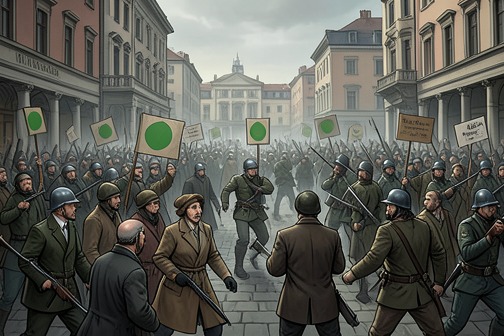
The [Nio Esseia](entity:location-recall-location-nio-esseia-f772168c8bdc) general-strike demonstration and [Capitol Square](entity:location-recall-location-capitol-square-89b6f4ddb428) massacre turn a mass protest into a direct confrontation between collective political action and state force. Organized amid unemployment, rising prices, taxes, and opposition to conscription, the demonstration brings the green Circle of Life into the streets and places [Shevek](entity:character-recall-character-shevek-c03b61cb02ce) before a vast crowd. His appeal to solidarity and freedom is answered not with debate but with an armed attack, dispersal, and deaths; the word “DOWN,” left on a wall inside the Directorate, survives the attempt to restore order.
## Causes and Political Stakes
The demonstration is announced for three days after Shevek meets with Maedda and other underground organizers. Nio Esseia has four hundred thousand unemployed people, while taxes and food prices are rising. The planned action opposes the draft, war taxes, and higher prices; its organizers also hope for a general strike on the scale of the [Ninth Month Strike](entity:time-recall-time-ninth-month-strike-7a9bace62bbf) associated with [Odo](entity:character-recall-character-odo-5a1f3aaae2aa). Maedda describes the city as ready for upheaval and presents the struggle as a question of making justice locally, rather than waiting for an outside settlement.
The protest’s stakes exceed its immediate demands. The organizers work across syndicalist and libertarian currents and cooperate with the Thuvianists and the Socialist Workers Union, while remaining anti-centralist. Maedda explains that the people of [Nio](entity:location-recall-location-nio-85927403d9aa) have long drawn hope from the existence of [Anarres](entity:location-recall-location-anarres-8af77930b83c), a society without government, police, or economic exploitation. He argues that Shevek is politically consequential not simply because of his scientific theory, but because his presence makes the possibility of anarchism visible. The demonstration therefore joins opposition to immediate economic and military policies with a broader challenge to political power.
That challenge takes place in a society where state authority has already invoked war to impose controls. The government describes the conflict with [Thu](entity:location-recall-location-thu-cf94fc430d08) as a limited police action, yet says that official war status brings restrictions on research classification, publication, and the movement of non-nationals such as Shevek. The contrast between the government’s language of limited conflict and its power to restrict ordinary activity provides the political setting for the protest and its repression.
## The March and the Crowd
The demonstration’s signs connect its demands to a longer history. Alongside the placards for the general strike and the blue-and-white banners of the Syndicalists and Socialist Workers are homemade images of the green Circle of Life, the old symbol of the [Odonian Movement](entity:organization-recall-organization-odonian-movement-43b9bf659681). Anarres has no flag to wave, but the sign gives the crowd a shared emblem drawn from the tradition that inspired the strike. Shevek, recently hidden in rooms and basements, finds the experience of walking among thousands both frightening and exhilarating. The crowd’s singing intensifies that mixture of fear and collective purpose.
At Capitol Square, the gathering reaches a scale that defeats ordinary counting. The narrative estimates that a hundred thousand people, or perhaps twice that number, have assembled; individual positions and actions cannot be calculated, yet as a mass the crowd follows the organizers’ plan. People march in order, sing, fill the Square and surrounding streets, and listen to speakers. Shevek compares the gathering with [Abbenay](entity:location-recall-location-abbenay-98fb15d5f0b8), where the number of people in the Square exceeds the population of the Anarresti city, but recognizes that such comparison cannot contain the experience of being among them.
Shevek stands with Maedda and the other organizers on the steps of the Directorate, in front of its columns and tall bronze doors. The crowd listens to speakers whose amplified voices echo from the Senate and Directorate buildings. When Shevek speaks, he understands the act less as a separate performance than as a shared exchange: he feels that he is speaking the crowd’s mind in its own language. The scene makes the demonstration a public act of collective appearance, with the assembled people not merely receiving a message but becoming a political body through their presence and attention.
## Shevek’s Speech and the Attack
Shevek’s address defines solidarity through shared vulnerability rather than sentiment or command. He speaks of suffering, hunger, poverty, and hope as experiences that people endure individually but recognize in common. [Mutual aid](entity:concept-recall-concept-mutual-aid-24124ff16a3b) follows from that condition: people cannot wait for an external rescuer and must reach out to one another. His description of freedom rests on having no property to command others with and on being able to give what one is, rather than what one owns.
He also connects the crowd’s immediate struggle to the promise made in Nio two centuries earlier and kept on Anarres. He describes Anarres as a society without states, bosses, bankers, landlords, police, soldiers, or wars, while acknowledging that it is neither prosperous nor powerful. Its example cannot be transferred as a possession or bought as a political instrument: those seeking such a future must enter it without property and become responsible participants in it. His final formulation makes revolution a condition of individual conduct and spirit, not an outcome that can be manufactured or purchased.
The speech ends as police helicopters approach and drown out his voice. Their noise gives way to gunfire from the aircraft; the attack is concentrated on people standing on or near the Directorate’s steps. The building’s portico offers immediate shelter, while people in the Square press toward its eight exits. The passage presents the violence as a rupture of public speech: the gathering that had assembled to listen and act together is forced into panic and flight.
The bronze-sheathed doors of the Directorate give way under the pressure of the crowd. People push into the marble halls, some seeking shelter, others trying to cross the building and escape, and still others remaining to damage what they can before soldiers arrive. The troops enter in orderly formation among the dead and dying. On the foyer’s grey wall, someone has written [“DOWN”](entity:expression-recall-expression-down-7e1bd7d3cd4a) in blood. Soldiers shoot the dead person nearest the word, and officials later wash it from the wall with soap, water, and rags. The attempt to remove the mark does not erase its public meaning: the word has been spoken and seen.
## Aftermath and Significance
The demonstration’s defeat does not end with the attack in the Square. Shevek later recounts that police and army forces push the crowd along Mesee Boulevard toward [Old Town](entity:location-recall-location-old-town-662418b2ff4a), using armored cars to drive people forward while helicopters move above the streets. The mass gathering breaks into smaller groups and individuals trying to escape; Shevek helps an exhausted companion away from the main crowd. The suppression thus changes the immediate political scene from organized march and public speech into flight and survival.
The attack also clarifies what Shevek’s presence means to both the organizers and the government. The Terran ambassador later observes that the demonstration’s scale, popular intensity, and the government’s panicked response are difficult to explain if the protest is understood only as a demand for better wages or a response to conscription. She recognizes that the demonstrators belong to an anarchist tradition and that the government has treated Shevek as dangerous partly because he embodies that tradition. In her view, bringing him to [Urras](entity:location-recall-location-urras-cc6169219e59) while keeping him away from the populace was like bringing a match to a powder mill; the demonstration shows the political force that his carefully restricted presence could release.
The massacre’s central contrast is between the crowd’s practiced coordination and the state’s coercive power. The people assemble, march, listen, and speak without becoming a predictable collection of individually controlled units; Shevek’s address insists that freedom depends on mutual aid and free association. The helicopters and armed forces answer that association with force. Yet the ending refuses a simple equation of physical suppression with political erasure: the gathering is dispersed and the wall is scrubbed, but “DOWN” remains as a remembered declaration of opposition.
Event 14
Shevek’s Breakthrough in General Temporal Theory
[Shevek’s Breakthrough in General Temporal Theory](entity:event-recall-event-b9d806e58535) is the intellectual turning point in [Shevek](entity:character-recall-character-shevek-c03b61cb02ce)’s work: he discovers that progress depends not on securing an unassailable foundation, but on accepting a premise that cannot be proved and using it to move beyond an impasse. His new method unites [Sequency and Simultaneity](entity:concept-recall-concept-sequency-and-simultan-2e9a093f5a99), reconnects him with work he had set aside, and makes possible the theory from which the ansible may be built.
## The Impasse and the Changed Premise
For ten years, Shevek had been struggling with the problem of real coexistence. During his stay on [Urras](entity:location-recall-location-urras-cc6169219e59), the difficulty had become immediate again: for three days he had been trying to resolve whether the hypothesis of coexistence could be proved. His breakthrough begins when he recognizes what that demand for proof has been doing to his thinking. He had been reaching for certainty as though it were something he could possess, asking for a guarantee that could not be granted—and that, if granted, would itself become a prison.
The reversal is not a new proof of the hypothesis. Shevek instead sees that he can assume the validity of real coexistence and proceed. A theory whose elements are all provably true, he reasons, may be no more than a tautology; the unprovable, or even the disprovable, is where there may be room to break out of a closed circle. The breakthrough changes the status of uncertainty: rather than a defect that blocks inquiry, it becomes a condition under which thought can advance.
## A Method for Unifying Time
With the premise accepted, the next step becomes clear. Shevek sees that the coexistence of succession can be handled by a Saeban transformation series. Successivity and presence no longer have to stand as opposing accounts of time: the concept of interval can connect the static and dynamic aspects of the universe. The insight brings the Sequency and Simultaneity points of view into fundamental unity, giving his temporal physics a method for moving between them rather than choosing one at the expense of the other.
The realization also reorganizes Shevek’s sense of the scientific past. His understanding of the failure of [Ainsetain](entity:character-recall-character-ainsetain-64200ca2a050)’s attempt at a unified field theory provides a glimpse of the method he needs. In Shevek’s account, the earlier physicist’s intuition had been sound, though the tools needed to complete the synthesis were unavailable. The decisive lesson is not that earlier work was worthless, but that an incomplete effort can expose the point from which another thinker can proceed. Shevek recognizes that he has already made that next move, even before he had understood what it was.
## Revelation and Consequence
The breakthrough arrives not as a slow accumulation of assurances but as a sudden, comprehensive change in what Shevek can see. He understands the method as simple enough to be clear, yet capable of containing complexity and promise. [The wall](entity:expression-recall-expression-the-wall-470106c3d1b7) that had obstructed his view is down; the way forward is open. The revelation brings happiness and fear together, and Shevek’s tears and trembling register the cost of grasping that his life’s work has reached fulfillment. The moment resolves a long intellectual blockage without suggesting that thought itself has reached an end: the insight makes continuation possible.
That continuation has practical stakes beyond Shevek’s own research. On Urras, he distinguishes the work he does from engineering or invention: he is a theorist, and what is wanted from him is a theory of the General Field in temporal physics. He explains that his equations might enable the ansible, even if they do not produce transilience, the instantaneous transfer of matter across space. The distinction matters: the breakthrough supplies theoretical ground for a possible technology, not a claim that Shevek has already invented it.
## The [Ansible](entity:object-recall-object-ansible-5d41c9fc90dd) and the Reach of the Theory
Shevek describes the ansible as an idea for a device that would permit communication between two points in space without any time interval. It would not literally transmit messages; simultaneity would function, to human perception, as transmission. In practical terms, it would work like a telephone between worlds, avoiding the long wait required for electromagnetic signals and replies. The possibility gives the abstract relation between succession and presence a far-reaching consequence: information could be shared across interstellar distances without being delayed by travel time.
[Keng](entity:character-recall-character-keng-aa9da29f851b) understands the human scale of that possibility through her own separation from home. After traveling from [Terra](entity:location-recall-location-terra-498b3a9a0c69) to Urras in a nearly light-speed ship, she could imagine speaking with her son in Delhi and learning what had happened during the years she had been away, rather than receiving news from the time she left. She also envisages decisions and agreements being made across worlds without generations of delay. Shevek’s breakthrough therefore connects a difficult problem in temporal physics to a prospect that could alter communication among the billions of people in the nine Known Worlds. The theory’s significance lies both in its unification of two views of time and in the possibility that it may let ideas cross distances that bodies cannot.
Event 15
Anarres–Urras radio contact
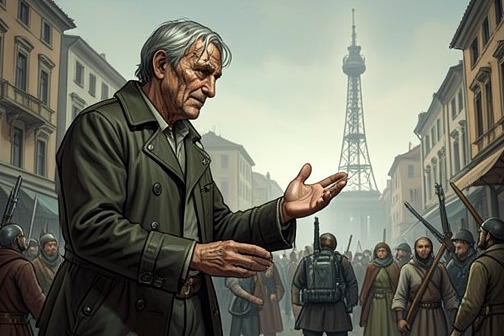
[Anarres–Urras radio contact](entity:event-recall-event-anarres-urras-radio-con-09b8f13e8b13) is an independent communications project that breaks the long political silence between the planets and forces [Anarres](entity:location-recall-location-anarres-8af77930b83c) to confront what openness might cost. Organized by [Bedap](entity:character-recall-character-bedap-725a11cb5594) and the [Syndicate of Initiative](entity:organization-recall-organization-syndicate-of-ini-a0dabb78f7c3) against the [PDC](entity:organization-recall-organization-pdc-0178fd73f7f5) majority’s recommendation, it carries information in both directions, becomes a source of public controversy, and opens the possibility of bringing visitors to Anarres. For [Shevek](entity:character-recall-character-shevek-c03b61cb02ce), contact is not merely technical: it is part of a larger effort to dismantle isolation and make knowledge a common gift rather than a commodity or instrument of power.
## The Initiative and Its Opposition
By the time Bedap presents the Syndicate of Initiative’s project to a PDC council, the group has been in radio contact with [Urras](entity:location-recall-location-urras-cc6169219e59) for about twenty decads. Bedap proposes inviting a small group of Urrasti to Anarres, extending communication from broadcasts to face-to-face contact. The project has proceeded without the approval of the PDC majority or the Defense Federative, and against growing protests from the Brotherhood.
The broadcasts and their publication have made the Initiative’s actions visible well beyond its own membership. Bedap recalls that he and Shevek had first discussed how a frustrated physicist might print his work and communicate with physicists on Urras; once radio contact was established, the Urrasti proved more eager to exchange information than the organizers expected. Reports of those exchanges, in turn, provoked a more virulent opposition on Anarres than Bedap had anticipated. Attention from both planets leaves him wondering whether the Initiative’s members are traitors, even as their purpose is to open communication.
[Rulag](entity:character-recall-character-rulag-f4723d9ee7ed), an engineer and the Initiative’s determined opponent, treats the proposal to receive visitors as a danger of a different order from broadcasting. She argues that the group has acted irresponsibly by persisting against advice and protest, and that its broadcasts disclose Anarres’s weakness to a powerful enemy. Her imagined progression—from a handful of visitors, to profiteers inspecting the planet, to armed ships and occupation—turns the question of contact into a question of collective survival. She grounds her case in the Terms of the Settlement, which bar Urrasti from leaving their ships except for the original Settlers, and warns that opening the door could undo the security on which Anarres has relied.
## Contact Across Unequal Worlds
The radio project takes place against a broader imbalance in how the two planets communicate and represent one another. On Urras, Shevek encounters newspapers that turn his arrival into a spectacle: one calls him the “FIRST MAN FROM THE MOON!” and attributes to him a declaration of brotherhood that he says he never made. Pae explains that the paper’s reporters had not been allowed near him and had invented the quotation. The episode shows that connection does not ensure that a speaker’s words will be heard accurately; established media can substitute a convenient image for the visitor’s actual speech.
Pae also contrasts [A-Io](entity:location-recall-location-a-io-fcd52e3420b2)’s press with the state-controlled paper from [Thu](entity:location-recall-location-thu-cf94fc430d08). A-Io’s newspapers may be sensational and poorly informed, while Thu’s government publication is better written but reports only what the Central Presidium permits. These competing forms of control make the radio contact politically charged: information can circulate, but its meaning remains vulnerable to ownership, censorship, and distortion.
The material conditions on Anarres sharpen the stakes of communication. PDC coordinates long-distance mail, calls, travel, and shipping; correspondence is limited, often delayed, and generally unsealed by convention because carrying a private message consumes shared labor and materials. In a society where people can move and seek friends where they are, personal letters are relatively few. The radio project thus introduces a new scale and immediacy of exchange into a system in which even ordinary long-distance communication is coordinated as a collective resource.
## Shevek’s Political Purpose
Shevek understands his presence on Urras as a negotiation with a society organized around buying and selling. Arriving without money or gifts, he calls himself the “Beggarman” and explains that, because he cannot buy what he needs, his hosts must give it if they choose to keep him alive. His empty hands make the contrast between Anarresti sharing and Urrasti commerce concrete; the same contrast later shapes his account of scientific exchange.
When [Chifoilisk](entity:character-recall-character-chifoilisk-d42dce4ec0c0) warns him that A-Io’s hospitality serves a profit economy rather than disinterested science, Shevek replies that he came to bargain. He wants his people to come out of exile, free exchange between Urras and Anarres, and the walls between them brought down. He believes A-Io fears him less than Thu because A-Io has forgotten the revolution and assumes that possessions can make people content within confinement. Contact is therefore bound to a political objective: exchange must challenge isolation rather than simply serve the interests of the powerful.
That principle culminates in Shevek’s offer to give his theory to Urras, [Hain](entity:location-recall-location-hain-aee202d20a49), and the other worlds. He rejects selling it to the propertarians and argues that no one country should be able to use it to gain power, wealth, or military advantage over others. The proposal recasts communication as a gift made for the common good, and connects the radio project’s exchange of reports to a far-reaching demand for open access to knowledge.
## Consequences and Significance
Anarres–Urras radio contact changes the terms of debate inside Anarres. Before the broadcasts, Urras could remain a distant danger described through inherited fears; once information is received, discussed, and published, the possibility of learning how the other world actually works becomes a practical political question. Bedap acknowledges that the exchanges drew more interest from Urras and more hostility at home than the organizers had expected. Rulag’s warning shows the counterargument at its strongest: openness might expose Anarres to domination, but refusing contact preserves ignorance as well as safety.
The proposed visit brings that tension to a threshold. A few people arriving on a freighter would make the boundary between the worlds physically permeable, where radio waves and published reports had already crossed it informationally. The dispute is not resolved by treating communication as harmless: the same channels can enable solidarity, disclose vulnerability, or be used by states and property-holders to gain advantage. The radio contact matters because it makes Anarres decide whether its founding promise can survive contact with the world it has kept outside—and whether isolation protects freedom or slowly turns protection into a closed door.
Event 16
谢维克赴乌拉斯之行
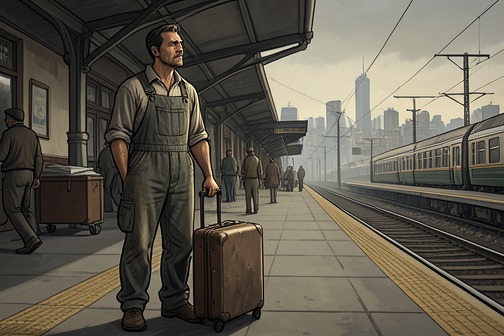
[Shevek](entity:character-recall-character-shevek-c03b61cb02ce)’s visit to [Urras](entity:location-recall-location-urras-cc6169219e59) is both a journey across worlds and a test of the terms on which they can meet. Arriving without money or gifts in a society organized around purchase, he first calls himself a beggar and later describes his purpose as bargaining for human solidarity and free exchange. But the decisive bargain he rejects is the sale of scientific truth for private advantage: he wants his theory shared with Urras, [Hain](entity:location-recall-location-hain-aee202d20a49), and other worlds for the common good. His departure from Urras aboard the interstellar [Davenant](entity:object-recall-object-davenant-a013b4302850) makes the visit’s reversal visible: he returns to [Anarres](entity:location-recall-location-anarres-8af77930b83c) carrying no purchased reward, but having asserted that knowledge need not be owned.
## The Decision to Go
The visit begins as a possibility discussed in the context of Shevek’s work and his exclusion from appreciation, discussion, and students on Anarres. [Takver](entity:character-recall-character-takver-9335299dd0a6) argues that he needs those things without the strings attached to [Sabul](entity:character-recall-character-sabul-4d1d4a30ffd4)’s influence, and that the right to visit Urras should be exercised rather than left as a threat to [PDC](entity:organization-recall-organization-pdc-0178fd73f7f5) custom. She also points to his own interest in meeting physicists and seeing the light experiments at [Ieu Eun](entity:location-recall-location-ieu-eun-429298b1bd92). Shevek admits that he would like to see the laboratories, then frames the journey as more than professional opportunity: it might help keep the Revolution alive on both sides.
That purpose is deliberately double. Shevek imagines going to Urras to subvert the archists, while recognizing the limits of what a visiting physicist can change. His presence could at least demonstrate that Anarres exists; his work might unsettle Urrasti physics even if it did not transform Urrasti opinion. The decision therefore binds scientific curiosity to a political wager: contact might challenge isolation, but it cannot guarantee that either society will understand the other.
## Arrival Without Property
On the journey to Urras, Shevek experiences the rules of exchange in practical terms. When told his luggage may have been lost in the rush to board, he replies that he brought nothing. His bleached, slightly shrunken suit still fits, and its familiar holum-fiber texture helps him feel like himself again. He explains the material difference between the societies: in Urras, one must buy; without money, he cannot buy food, and cannot carry enough food to provide for himself. If he is to be kept alive, someone there must give it to him. He calls himself the Beggarman and makes the dependence plain rather than disguising it as an ordinary transaction.
The same point recurs when he is offered clothes and small necessities. Shevek says that he could not bring money because Anarres does not use it, nor gifts because its people use nothing Urras lacks; he has come, as an Odonian, “with empty hands.” His hosts reassure him that he is their guest and that no payment is expected, while [Chifoilisk](entity:character-recall-character-chifoilisk-d42dce4ec0c0) notes that the [Ioti Government](entity:organization-recall-organization-ioti-government-b90c6a0c2586) is paying the bill. Hospitality thus gives Shevek room to live, but it also places his visit inside an arrangement funded by the state whose interests he has come to negotiate with. The contrast between giving and paying is not abstract: it determines who supplies his food and clothes, and who underwrites his presence.
## Bargaining, Not Submission
Shevek openly tells Chifoilisk that he came to bargain with the profit economy. His purpose is not to obtain personal wealth. He wants the people of Anarres to come out of exile, the walls between the worlds to fall, and Urras and Anarres to enter into free exchange and human solidarity. He distinguishes his work on the two planets: on Anarres he acted as he could; on Urras he bargains. The distinction makes his visit a political act conducted through the very economic order he opposes, rather than evidence that he accepts that order as the natural basis of human relations.
The tension sharpens when Chifoilisk warns him that the Ioti are treating him well because they expect a return. Shevek acknowledges the profit economy but insists that he came to bargain with it. Later, he names the danger more precisely: the propertarians may buy the truth from him. His scientific work was made within an idea of freedom, change, and human solidarity; allowing that work to serve private power would betray the purpose that gave it meaning. The visit’s central conflict is consequently not whether Shevek can succeed as a celebrated scientist, but whether his knowledge can be detached from the common good and turned into an instrument of possession.
## The Gift of the Theory
Shevek answers that danger by asking whether selling is the only alternative and whether a gift is possible. He wants to give his theory to Urras, Hain, and the other worlds—not to one recipient able to use it to gain power over others, grow richer, or win more wars, but for the common good. His proposal is a concrete extension of the empty-handed arrival: on the outward journey, he has nothing to buy his necessities with; at the end of his negotiations, he offers something valuable without claiming a private price for it.
[Keng](entity:character-recall-character-keng-aa9da29f851b) observes that truth will usually insist on serving the common good eventually. Shevek refuses to wait for that eventuality. He has one lifetime, he says, and will not spend it serving greed, profiteering, and lies; he will serve no master. The offer therefore sets a limit on the political bargain. Shevek does not merely hope that useful knowledge will escape control over time: he acts to prevent one government from possessing it as a source of advantage. The gift is both a scientific decision and a refusal to let the terms of Urrasti exchange determine who may use the truth.
## The Journey Home
Before the ship breaks orbit, Urras fills the viewports with cloudy turquoise, immense and beautiful; then the vessel turns, and Anarres appears among the stars like a round bright rock. The interstellar Davenant is unlike the freighter [Mindful](entity:object-recall-object-mindful-d42272acac89) that brought Shevek to Urras. Spacious and quiet, with private rooms and a garden lit like sunlight, it occupies a middle ground between Urrasti opulence and Anarresti austerity. Its balanced, carefully livable design provides the setting for the return, but Shevek gives little attention to the ship or its crew during the three-day passage at conventional speeds.
He is absorbed instead by Anarres ahead. The narration describes him as aware of hope deceived and promise kept, of failure, and of joy released from within him; he feels like a man released from jail, going home to his family. The return is not presented as a simple victory that erases the visit’s costs. It gathers disappointment and fulfillment together, and locates Shevek’s renewed joy in the prospect of home. On the second day he speaks by radio with Anarres, first on the PDC wavelength and then with the [Syndicate of Initiative](entity:organization-recall-organization-syndicate-of-ini-a0dabb78f7c3). His attention to those contacts marks the return as a renewed connection with the people and institutions of his own world, rather than a private escape from Urras.
The journey’s ending also leaves contact open beyond Shevek’s own return. [Ketho](entity:character-recall-character-ketho-846746d1c56b), the Davenant’s first mate, has asked him questions about Anarres, and Shevek tells him that Anarres will contact the crew the next day to arrange the entry procedure. The visit thus ends not with a completed reconciliation between the planets, but with communication and a practical next step. Shevek comes home having rejected the conversion of his theory into private property, while the ship carries the possibility of further exchange across the separation he set out to challenge.
Event 17
Shevek’s Offer to Share His Theory
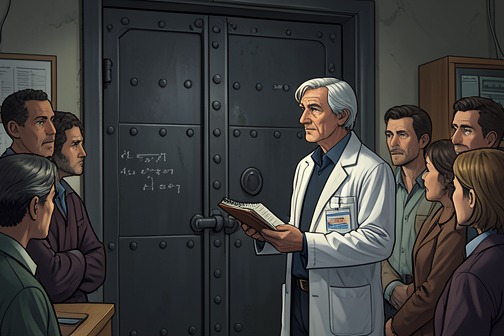
[Shevek’s Offer to Share His Theory](entity:event-recall-event-dc3afbc1a3dd) turns [Shevek](entity:character-recall-character-shevek-c03b61cb02ce)’s scientific achievement into a challenge to ownership: instead of allowing [A-Io](entity:location-recall-location-a-io-fcd52e3420b2) to control his completed work, he asks [Keng](entity:character-recall-character-keng-aa9da29f851b) to help broadcast its equations to physicists on [Urras](entity:location-recall-location-urras-cc6169219e59), [Hain](entity:location-recall-location-hain-aee202d20a49), and other worlds. The proposal answers both his need for intellectual exchange and his refusal to let knowledge become a private investment or weapon; it makes sharing a deliberate political act rather than a polite gesture.
## The problem of exchange
The offer grows out of the conflict between the societies’ different assumptions about giving and buying. When Shevek arrives on Urras without luggage, he explains to Dr. Kimoe that he could not bring enough food to sustain himself and cannot buy it because he has no money. He describes himself as the Beggarman and insists that if Urrasti choose to keep him alive, they must give him what he needs, as Anarresti give rather than sell. The point is not that he has brought an equivalent payment: he has come empty-handed into a society where basic provision is mediated by money.
Later, after reaching the home of [Atro](entity:character-recall-character-atro-c3f8853511b4) and [Saio Pae](entity:character-recall-character-saio-pae-cb09f7ef752b), Shevek again calls himself the Beggarman. He explains that he could bring neither money, which Anarresti do not use, nor gifts, since they use nothing Urras lacks. The hosts assure him that he is their guest and need not pay, while [Chifoilisk](entity:character-recall-character-chifoilisk-d42dce4ec0c0) notes that the [Ioti Government](entity:organization-recall-organization-ioti-government-b90c6a0c2586) is covering the cost. The exchange makes hospitality inseparable from unequal economic arrangements: Shevek is welcomed, but his visit is funded by the government whose interests he will question.
That tension becomes explicit when Chifoilisk warns him that the Urrasti around him are not acting from brotherly love and that A-Io is a profit economy. Shevek does not claim to have misunderstood the bargain; he replies that he came to bargain with it. He wants his people to come out of exile, the walls between Urras and [Anarres](entity:location-recall-location-anarres-8af77930b83c) to come down, and the worlds to exchange freely. On Anarres he had acted for that aim; on Urras, he says, he bargains. The theory’s eventual fate is therefore bound to a wider political purpose from the start.
## A completed theory and an unfinished choice
Shevek tells Keng that isolation on Anarres had obstructed his work: he could not finish it there, and even if he had, his society had seen no use for it. On Urras, conversation, teaching, a Light Laboratory experiment, and access to a book of Relativity Theory from another world supplied the stimulus he needed. The work is complete in his mind, he says, with its equations and reasoning, though it has not yet been written out. Scientific progress in his account depends not on sealed individual possession but on contact among people and ideas.
That achievement sharpens the ethical problem. Shevek recognizes that by pursuing physics alone he has betrayed the other idea that formed him: his society’s commitment to freedom, change, and human solidarity. He believes he is allowing propertarians to buy the truth from him. His question to Keng—whether there is an alternative to selling, whether there can be a gift—recasts the issue. The choice is not simply between keeping the theory and transferring it; it is between a controlled transaction and an open act of giving.
Shevek explains that he wants to give the theory to Keng, Hain, and the countries of Urras, so that no one power can use it to dominate others, grow richer, or win more wars. Its purpose should be the common good, not private profit. When Keng suggests that truth usually serves the common good in the end, Shevek rejects waiting for that eventual outcome: he has only one lifetime and will not spend it serving greed, profiteering, and lies. He will serve no master. The offer thus responds to the practical danger of appropriation with an immediate alternative, rather than trusting that knowledge will somehow escape control later.
## The offer to broadcast
Shevek puts the proposal directly to Keng: he came to her to give her his theory and save it from becoming Ioti property, an investment, or a weapon. The simplest course, he suggests, is to broadcast the equations as soon as possible to physicists throughout this world, to the Hainish, and to other worlds. Keng agrees. Shevek estimates that the equations will amount to only a few pages; proofs and implications will require more work, which other people can undertake if he cannot.
The scale and form of the proposal matter. Shevek is not offering an exclusive manuscript to a patron or asking Keng to decide who deserves access. He proposes transmitting a compact body of knowledge widely and promptly, while leaving its further development open to other workers. In this way, the broadcast would make scientific communication cross political boundaries and would deny any one government the sole claim to the theory. Its public form enacts the freedom of exchange that Shevek had sought throughout his visit.
## From personal gift to social risk
The offer resonates with a debate already underway on Anarres over contact with Urras. The [Syndicate of Initiative](entity:organization-recall-organization-syndicate-of-ini-a0dabb78f7c3) has built a transmitter, broadcast to Urras, received communications, and published them despite opposition from much of the [PDC](entity:organization-recall-organization-pdc-0178fd73f7f5) and the Brotherhood. [Rulag](entity:character-recall-character-rulag-f4723d9ee7ed) warns that sharing scientific information with a powerful enemy exposes Anarres’s weakness and argues that allowing Urrasti onto the planet could lead from a small visiting group to profiteers, invasion, and the end of the settlement’s promise. The assembly ultimately accepts that no Urrasti will come on the Kuieo Fort or the [Mindful](entity:object-recall-object-mindful-d42272acac89). Shevek then distinguishes that question from whether an Anarresti may travel to Urras, arguing that forbidding a harmless individual act would give the PDC authority the settlement terms do not grant it.
In defending that principle, Shevek says Anarresti came to Anarres for freedom, not safety. He argues that solidarity cannot mean functioning like a machine under the rule of the majority: individuals must be able to initiate acts, work alone when necessary, and accept responsibility. His conclusion that revolution exists in the individual spirit links personal initiative to the society’s capacity to change. Rulag counters that he has no right to involve everyone in a risk compelled by private motives. The dispute gives the theory’s circulation a larger political context: openness may expose a community to danger, but preventing every risky initiative can itself become a form of authority.
Shevek’s proposed gift does not erase that disagreement or guarantee how other worlds will use the theory. It establishes what he is willing to do: refuse exclusive control, invite others to participate in the work, and make the knowledge available before its eventual use can be dictated by a single government. In the novel’s contrast between exchange as purchase and exchange as shared action, the offer is both a scientific communication plan and a test of whether solidarity can cross the walls separating societies.
Event 18
Ketho’s Decision to Land on Anarres
[Ketho’s Decision to Land on Anarres](entity:event-recall-event-92d4abbc7422) is the final movement of [Shevek](entity:character-recall-character-shevek-c03b61cb02ce)’s return: a Hainish officer elects to cross the boundary that has kept [Anarres](entity:location-recall-location-anarres-8af77930b83c) closed to outsiders. His decision is personal rather than diplomatic, and Shevek makes its cost explicit. The landing will enter a society already unsettled by the changes Shevek’s journey was meant to provoke, where [Ketho](entity:character-recall-character-ketho-846746d1c56b) cannot rely on official status or a safe reception. The scene ends not with arrival but with a launch procedure about to begin, leaving the act of crossing the wall poised between intention and consequence.
## A Closed Settlement and an Unusual Request
Anarres’s exclusion of foreigners rests on the [Terms of the Closure of the Settlement of Anarres](entity:object-recall-object-terms-of-the-closure-o-b72dd2b1d80b). In a discussion on [Urras](entity:location-recall-location-urras-cc6169219e59), [Rulag](entity:character-recall-character-rulag-f4723d9ee7ed) states that anyone may leave Anarres if a propertarian freighter will take them, but that they cannot return: no one may disembark from a freight ship beyond the boundary of the [Port of Anarres](entity:location-recall-location-port-of-anarres-6d3478c40bba). Her formulation makes the rule more than a practical restriction on travel. The boundary separates departure from return, and turns the port into the limit of who may enter the settlement.
The terms’ scope is contested. An old adviser argues that they were meant to apply to Urrasti, not Anarresti, while Rulag answers that a person coming from Urras is Urrasti. Later, Shevek distinguishes Ketho from that category: the Hainishman is not an Urrasti. Ketho notes that when Anarres was settled, no other races were known; the prohibition’s application to all foreigners was an implication, not an expressly stated rule. Shevek traces that broader interpretation to Anarres’s managers, who adopted it sixty years earlier, when people from [Hain](entity:location-recall-location-hain-aee202d20a49) first entered the solar system and tried to speak with the Anarresti. He believes the managers were wrong to extend the restriction in this way, describing the result as the construction of more walls.
## Ketho’s Choice and Shevek’s Warning
Ketho does not ask to land as a representative of a foreign government. He tells Shevek plainly that he would like to go with him, and explains that, as an officer of a mission ship, exploring and investigating a new world is part of his duty when possible. The ship’s commander and Ketho have discussed the possibility, as have their ambassadors before departure. Their ambassadors chose not to submit a formal request because Anarres’s policy forbids foreigners to land. The absence of a request therefore reflects respect for the prohibition, but it leaves the decision to be made personally rather than through an official agreement.
Ketho’s interest predates Shevek’s visit to Urras. Reading [Odo](entity:character-recall-character-odo-5a1f3aaae2aa)’s works made him curious about Anarres, and he has begun learning Pravic. When Shevek asks whether landing is Ketho’s own wish and initiative, Ketho confirms that it is entirely his own. His choice is not presented as a command, an assigned mission, or a diplomatic maneuver: it is a deliberate attempt to experience a social order he has encountered through Odo’s thought.
Shevek nevertheless refuses to make the choice seem safe. He tells Ketho that conditions on Anarres are “a little broken loose,” according to what his friends on the radio have reported. The journey of the Syndicate was intended to shake up settled habits and make people ask questions; while Shevek was away, that disruption continued, and nobody is sure what will happen next. Ketho’s presence would unsettle matters further. Shevek says he cannot take him as an official representative of a foreign government, a status that would not be acceptable on Anarres, and warns that Ketho could find himself very much alone. Once across the wall, he would be treated as one of the community, responsible to it and answerable alongside its members, but subject to the same unsafe choices. Ketho understands the danger and does not withdraw his request.
## A Personal Crossing, Not a Diplomatic Arrival
The conversation turns on the difference between a rule’s inherited interpretation and the living choice of whether to enforce it. Shevek acknowledges that the Terms of the Closure still stand, but refuses to treat their extension to Ketho as self-evident. His opposition to the managers’ interpretation is tied to the changes underway on Anarres: the journey was meant to break habits, and allowing a person to land would press those questions into the present rather than leave them as abstract arguments about the settlement’s founding terms.
Ketho answers Shevek’s warning by placing his decision against the vast age of his own civilization. His people, he says, have been civilized for a thousand millennia and have histories stretching across hundreds of those millennia; they have tried many systems, including anarchism, but he has not tried it himself. He invokes the possibility that every individual life is new, even if nothing is new under any sun. Shevek answers in Pravic, “[We are the children of time](entity:expression-recall-expression-we-are-the-childre-f35ccadfa500),” and Ketho repeats the words in Iotic. Their exchange joins the promise of a new experience to the book’s insistence that history does not eliminate the individual’s capacity to begin.
The scene also reverses the usual direction of the crossing. Shevek has returned from Urras carrying knowledge and political disturbance, but Ketho now asks to travel the other way, not as an envoy shielded by a state but as an individual willing to take the risks of membership. Shevek’s welcome is conditional in an ethical rather than bureaucratic sense: Ketho is not offered a protected foreign status once he walks through the wall, but inclusion in mutual responsibility. The threshold is therefore not merely a line between worlds; it is a commitment to live among people without claiming exemption from their uncertain circumstances.
## From Intention to Launch
Ketho says he will speak to the commander. The decision then acquires an immediate practical consequence. The commander of the [Davenant](entity:object-recall-object-davenant-a013b4302850) enters the garden room with Ketho and reports that the ship has received the entry pattern for its landing craft from Anarres’s ground control. He asks whether Shevek is ready to begin the launch procedure, and Shevek agrees. The commander leaves, while Ketho comes forward to stand beside Shevek at the port.
The landing itself has not yet occurred in this scene. Instead, the preparations turn a freely chosen intention into imminent action: ground control has supplied the entry pattern, the commander is ready, and Ketho stands alongside Shevek as departure begins. The ending keeps the outcome open while making the boundary crossing unavoidable in the next step. Anarres’s isolation has been sustained by rules that prevent outsiders from disembarking; Ketho’s decision tests whether those rules can yield to individual initiative and shared responsibility. It does not resolve the tension between openness and danger. It makes that tension the condition of his arrival.